


EU-funded project to teach robot toddler to talk
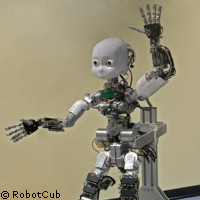
An EU-funded project is to attempt to educate a humanoid robot called 'iCub' which, at a metre tall, is the same size as a three-year old toddler and is able to crawl, sit up, feel, see and hear. The four-year Integration and Transfer of Action and Language Knowledge in Robots (ITALK) project will teach the so-called 'toddlerbot' how to develop cognitive skills, using processes similar to the ways parents develop these skills in their children. Led by the University of Plymouth, the consortium received an EU grant of €6.2 million to carry out their project. The project is expected to bring cognitive robotics research closer to the development of humanoid robots who can think, act and talk like human beings. An important skill here would be the development of 'learning' and updating available knowledge with the help of stimuli from an external environment. To begin with, iCub will learn simple activities such as fitting objects of different shapes into their correct slots, nesting objects of different sizes, and stacking blocks - in short, activities that help infants develop certain cognitive skills. The next step would be to teach it how to name objects and describe actions such as 'robot puts stick on cube. Scientists will also work on developing iCub's language skills in association with language researchers, who have studied how parents help their children learn to talk. Researchers aim to imbibe language skills in iCub, so that the robot can teach itself how to talk. Whatever the robot learns individually and socially should help to develop its language skills, which in turn, should help iCub interact better with its environment and pick up more knowledge to learn more. Knowledge of grammar and vocabulary is also likely too emerge naturally through this process. 'Our approach is that robot will use what it learns individually and socially from others to bootstrap the acquisition of language, and will use its language abilities in turn to drive its learning of social and manipulative abilities,' says Professor Chrystopher Nehaniv from the University of Hertfordshire's School of Computer Science, one of the project partners. 'This creates a positive feedback cycle between using language and developing other cognitive abilities. Like a child learning by imitation of its parents and interacting with the environment around it, the robot will master basic principles of structured grammar, like negation, by using these abilities in context.' The scientific and technological research developed during the project is expected to have a significant impact on the future generation of interactive robotic systems within the next ten years and the leadership role of Europe in this area. 'iCub will take us a stage forward in developing robots as social companions. We have studied issues such as how robots should look and how close people will want them to approach and now, within a year, we will have the first humanoid robot capable to developing language skills,' says Professor Kerstin Dautenhahn, who is also from the University of Hertfordshire's School of Computer Science.