


Europe, US team up on missions to Jupiter and Saturn
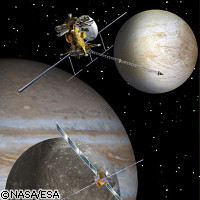
A landmark decision was recently made by space agency giants to collaborate on two major endeavours: missions to study the planets Jupiter and Saturn, and their surrounds. The European Space Agency (ESA) and the United States' National Aeronautics and Space Administration (NASA) have agreed to merge their plans, signalling a leap forward in industry partnership, and most importantly, for the exciting potential of new knowledge on our solar system. What began as separate mission ideas being developed almost simultaneously by the two agencies has now resulted in a carefully considered merger, with the notion of drawing together the best concepts on offer from both sides. For planetary science research, this partnership means the promise of answering one of the field's most lingering and unrelenting questions: do habitable conditions exist beyond our own planet? 'This joint endeavour is a wonderful new exploration challenge and will be a landmark of 21st century planetary science,' remarked ESA Director of Science and Robotic Exploration, David Southwood. 'What I am especially sure of is that the cooperation across the Atlantic that we have had so far and we see in the future, between America and Europe, NASA and ESA, and in our respective science communities is absolutely right. Let's get to work.' In 2008, NASA selected two mission concept proposals (from an original four presented in 2007); one was to explore Europa, the moon of Jupiter, and its subsurface water ocean, and the other was to revisit Saturn's moon, Titan. Similarly, as a result of a competition in 2007, ESA was also in a position to select from two finalists for its flagship mission; one to orbit Jupiter (and possibly land on Europa), and the other to orbit and explore both Titan as well as explore another of Saturn's moons, Enceladus. ESA and NASA officials met in the US capital of Washington in mid-February to study the proposals from both sides and discuss the feasibility of working together on the missions, known as Europa Jupiter System Mission and Titan Saturn System Mission. A decision was made that the former would be implemented first, with a scheduled launch for 2020. The meeting signalled the first step in what will require more detailed study and planning before officially moving forward. 'The decision means a win-win situation for all parties involved,' said Associate Administrator for NASA's Science Mission Directorate Ed Weiler. 'Although the Jupiter system mission has been chosen to proceed to an earlier flight opportunity, a Saturn system mission clearly remains a high priority for the science community.' For the Jupiter mission, the plan proposed is that ESA and NASA will each build a spacecraft, both of which will be launched in 2020. The spacecraft will reach their destination in 2026, where they will spend the following three years undertaking research. The study will include detailed examination of Jupiter itself as well as its moons Io, Ganymede, Callisto and Europa (a moon considered to be of particular interest for the habitability question due to its putative ocean). The European contribution to the Jupiter mission will be overseen by ESA's Directorate of Science and Robotic Exploration, while NASA's Jet Propulsion Laboratory will manage NASA's involvement for NASA's Science Mission Directorate.