


Researchers observe carbon monoxide binding for first time
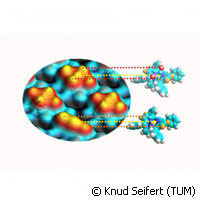
EU-funded researchers have for the first time succeeded in directly observing carbon monoxide binding to metal-porphyrines, a process that the research team will now use to explain the physical and chemical processes on surfaces and in nanostructures. The research was funded in part by the MOLART ('Surface-confined metallosupramolecular architecture: towards a novel coordination chemistry for the design of functional nanosystems') project, which has received a European Research Council (ERC) Advanced Grant worth EUR 2.57 under the EU's Seventh Framework Programme (FP7). The mechanism for binding oxygen to metalloporphyrins is a vital process for oxygen-breathing organisms. Understanding how small gas molecules are chemically bound to the metal complex is also important in catalysis or the implementation of chemical sensors. When investigating these binding mechanisms, scientists use porphyrin rings with a central cobalt or iron atom and coat a copper or silver support surface with these substances. An important characteristic of porphyrins is their conformational flexibility. Recent research has shown that each specific geometric configuration of the metalloporphyrins has a distinct influence on their functionality. In line with the current state of research, scientists from the Technische Universitaet Muenchen (TUM) in Germany expected only a single carbon monoxide (CO) molecule to bind axially to the central metallic atom. However, detailed scanning tunnel microscopy experiments revealed that, in fact, two gas molecules dock between the central metallic atom and the two opposite nitrogen atoms. According to the TUM research team, a critical component is the saddle shape of the porphyrin molecules, in which the gas molecules assume the position of the rider. The significance of the saddle geometry became apparent in model calculations carried out by Marie-Laure Bocquet from the University of Lyon in France. Her analysis helped the researchers understand the novel binding mode in detail. She also showed that the shape of the molecular saddle remains practically unchanged, even after the two gas molecules bind to the porphyrin. The porphyrins reacted very differently when the researchers replaced the CO with stronger-binding nitrogen monoxide (NO). As expected, this binds directly to the central atom, though only a single molecule fits in each porphyrin ring. This has a significant effect on the electronic structure of the carrier molecule, and the characteristic saddle becomes flattened, the researchers explained. The porphyrin, therefore, reacts very differently to different kinds of gas - a result that is relevant for potential applications, such as sensors. Dr Willi Auwaerter, one of the authors from TUM, expressed his excitement at the findings saying that 'what's new is that we actually saw, for the first time, the mechanism on a molecular level'. He added that 'we even can selectively move individual gas molecules from one porphyrin to another'. The team is now aiming to explain the physical and chemical processes on surfaces and in nanostructures. Once these fundamental questions are answered, they will take on new challenges and investigate a series of questions, namely: 'How big is the influence of the central atom? How does the binding change in planar conformations? How can such systems be utilised to implement catalysers and sensors through controlled charge transfers?'For more information, please visit: European Research Council (ERC) Advanced Grant:http://erc.europa.eu/index.cfm?fuseaction=page.display&topicID=66Technische Universitaet Muenchen (TUM):http://portal.mytum.de/welcome
Countries
Germany