


Local factors influence climate change in Antarctica
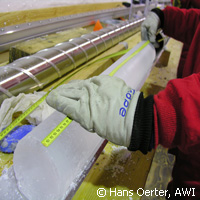
Scientists in Germany have challenged the traditional assumption that temperature fluctuations in Antarctica are mainly due to climate changes in the northern hemisphere. According to them, major portions of the temperature fluctuations on the continent can be explained equally well by local climate changes in the southern hemisphere. The climate researchers presented their findings in the journal Nature after studying temperature reconstructions based on ice cores. Variations in the orbit and inclination of the Earth have given decisive impetus to changes in the planet's climate over the last million years. At the beginning of the 20th century, Serbian mathematician Milutin Milankovitch calculated their influence on the seasonal distribution of insolation. He claimed that insolation changes in the northern hemisphere were of significant importance for climate change over long periods of time because land surfaces in particular react sensitively to changes in insolation, while the land masses on Earth are unequally distributed. Since then, his ideas have became the prevailing working hypothesis in climate research backed by numerous climate reconstructions based on ice cores, marine sediments and other climate archives. However, after re-analysing temperature reconstructions based on ice cores, three climate researchers from the Alfred Wegener Institute for Polar and Marine Research at Helmholtz Association (AWI) in Germany have questioned this belief. For the first time, scientists Thomas Laepple, Gerrit Lohmann and Martin Werner took into account the fact that winter temperatures have a greater influence than summer temperatures in the recorded signal in the Antarctic ice cores. If this effect is included in the model calculations, the temperature fluctuations reconstructed from ice cores can also be explained by local climate changes in the southern hemisphere. Moreover, says Professor Lohmann, the evidence gleaned from ice cores was supported by information gained from other sources. 'We were able to show that not only data from ice cores, but also data from marine sediments display similar shifts in certain seasons,' he points out. These findings suggested that 'there are still plenty of issues to discuss regarding further interpretation of palaeoclimate data'. For his part, Dr Laepple says 'Our results are also interesting because they may lead us out of a scientific dead end.' Indeed, until now many researchers have attempted to explain historical Earth climate data from Antarctica on the basis of Milankovitch's classic hypothesis. But as the scientist notes, 'to date, it hasn't been possible to plausibly substantiate all aspects of this hypothesis.' Dr Laepple believes that this new study means 'the game is open again and we can try to gain a better understanding of the long-term physical mechanisms that influence the alternation of ice ages and warm periods'. All three scientists emphasised that their findings do not call into question the understanding that the currently observed climate change is, for the most part, caused by human intervention. They comment that cyclic changes, as those examined in the Nature article, take place in phases lasting tens of thousand or hundreds of thousands of years. The drastic emission of climate gases by humans within a few hundred years has added to the natural rise in greenhouse gases after the last ice age and is unique for the last million years.For more information, please visit: Alfred Wegener Institute for Polar and Marine Research (AWI):http://www.awi.de/enNature:http://www.nature.com/
Countries
Germany