


The sounds of... lights
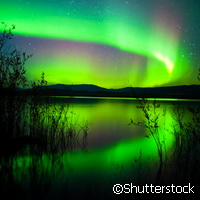
Our planet's polar regions are renowned for ice, snow and blustery cold. But these regions are also home to some of the world's most amazing phenomena, such as the aurora borealis, also known as the northern lights. Occurring mostly in a belt of radius 2,500 kilometres centred on the magnetic North Pole, the northern lights materialise over Alaska (United States), Canada, the southern tip of Greenland, Iceland, northern Scandinavia and the northern coast of Siberia. But what do we know about the sounds that are linked to these lights? Folklore and wilderness wanderers have long alluded to the auroral sounds, but no one has ever set the record straight. A team from Aalto University in Finland provides fresh, interesting answers in a never-before-performed study. They identified the location of where the sounds are created, around 70 metres above ground level in the measured case. The team installed three separate microphones at an observation site where the auroral sounds were recorded. They pinpointed the location of the sound source after comparing the captured sounds. The Aalto researchers said they saw the aurora borealis at the observation site. The Finnish Meteorological Institute conducted simultaneous measurements of the geomagnetic disturbances, demonstrating a typical pattern of the northern lights episodes. 'Our research proved that, during the occurrence of the northern lights, people can hear natural auroral sounds related to what they see,' said Professor Unto K. Laine from Aalto University. 'In the past, researchers thought that the aurora borealis was too far away for people to hear the sounds it made. This is true. However, our research proves that the source of the sounds that are associated with the aurora borealis we see is likely caused by the same energetic particles from the Sun that create the northern lights far away in the sky. These particles or the geomagnetic disturbance produced by them seem to create sound much closer to the ground.' In terms of getting more specific details about the development of auroral sounds, more work is needed. The sounds do not always emerge. The researchers went on to say that the recorded, unamplified sounds can be similar to crackles or muffled bangs which last for only a short period of time. These sounds have also been described as being distant noise. Due to these varied descriptions, the researchers believe different mechanisms are used to create these auroral sounds. They said the sounds are soft and varied. Anyone who is willing to listen to them must pay a great deal of attention.For more information, please visit:Aalto University:http://www.aalto.fi/en/
Countries
Finland