Listening in to the sounds of medieval Europe

Archaeologists often focus on visual aspects of the past. Others bring back ancient smells. Now through the field of archaeoacoustics, some are figuring out what sounds our ancestors might have heard. Understanding this aural culture can give us a deeper insight into the world they lived in, and even how they thought. “The sonic dimension is adjacent to the visual when we perceive the world around us,” explains Zorana Đorđević(opens in new window), postdoctoral fellow at the University of Barcelona(opens in new window). “It is essential to study the acoustic environment of sacred sites, as sound – intangible and ephemeral – acts as a bridge between the material and spiritual realms.” Through the CULT-AURAL project, funded with the support of the Marie Skłodowska-Curie Actions(opens in new window) (MSCA) programme, Đorđević focused on sounds broadcast from medieval monastic landscapes in Europe. “Archaeoacoustic research of medieval sites helps us go beyond just the visual and recognise the auditory as an equally important historical record,” remarks Đorđević. Through the project, Đorđević wanted to understand how far sound from large percussion instruments – bells, semantra, matraca – can travel and whether it creates a sonic network capable of transmitting messages. “What is truly exciting is that I am exploring the sounds of large percussion instruments that generations of our ancestors listened to daily,” she notes.
Examining percussion through acoustic fieldwork
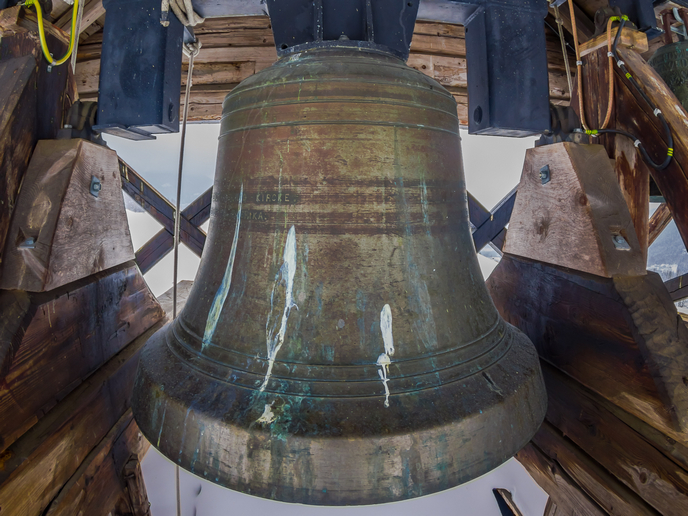
Đorđević explored the sounds of large percussion instruments and how they propagate across landscapes. She collected acoustic data through fieldwork campaigns in Catalonia, Norway and Serbia. These three distinct parts of Europe represent different Christian traditions (Catholic, Protestant and Orthodox) and three types of instruments: bells (present in all Christian practices); semantra (typically Orthodox); and matraca (found in Catalonia and common in regions historically influenced by Spain). “Such collected data was then post-processed and acoustically analysed,” adds Đorđević. “We then simulated the sound propagation of these instruments to explore the sonic network within a region and analysed the sounds of each instrument.”
Uncovering sonic historical references from the past
Among the broad range of results from the project, Đorđević highlights first the tonal analysis of 10 medieval bells(opens in new window) from the Valdres region of Norway. This revealed the distinctive voices of individual bells and how they might have shaped the acoustic soundscape. The team also created simulations of virtual sound propagation(opens in new window) with visibility analysis in Santa Maria d’Àneu, a church in Catalonia. This research explored the ecclesiastical role of the church in the valley, based on the visibility and audibility of the bells across the landscape. This uncovered an aural network of bells among local parishes and highlighted the Santa Maria d’Àneu as a central church in the valley. In 2025, together with her supervisor Margare ta Diaz-Andreu and a colleague Miquel López Garcia, Đorđević also co-organised the international conference Resonances of the Past: Archaeomusicological Research in Catalonia(opens in new window) at the Museum of Music in Barcelona. A co-edited volume arising from this conference will soon be published.
Research beyond archaeoacoustics
Đorđević says the MSCA postdoctoral fellowship was very rewarding in terms of scientific achievements and potential research directions. She is now seeking funding to further her research. “I have a very ambitious idea that extends beyond archaeoacoustics, and I look forward to sharing more about it soon,” she says.