Undersea cables can double as seismology and environmental sensors

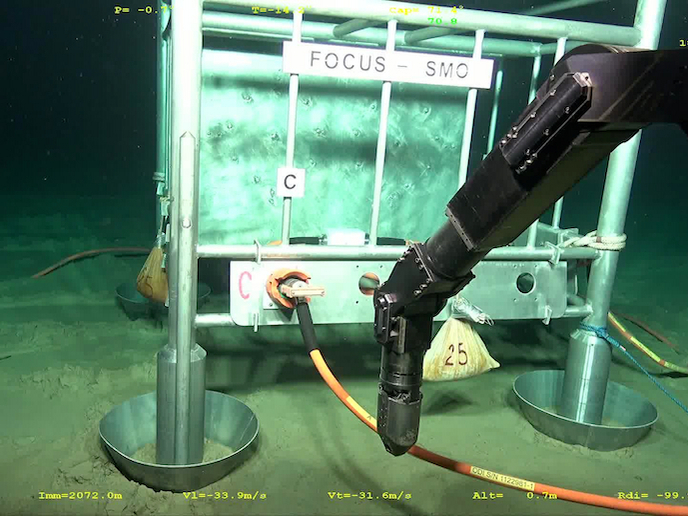
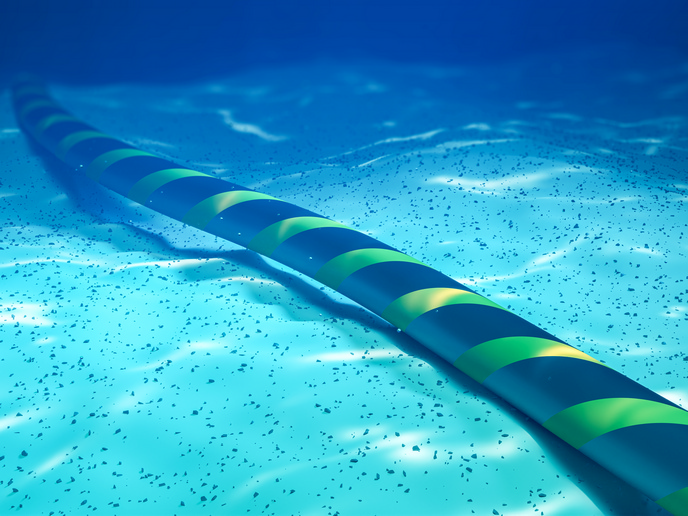
Knowing how and when the Earth’s faults move is key to seismology. But with two thirds of the Earth’s surface under water, significant monitoring opportunities are missed due to the logistical challenges and costs of deploying oceanic seismological instruments. “A smart oceanic seismology strategy is to piggyback on pre-existing infrastructure, and submarine telecom cables offer prime candidates,” says Marc-André Gutscher(opens in new window), coordinator of the FOCUS(opens in new window) project which used laser light to measure small seafloor movements through the strain detected in such cables.
Laser light detects changes to fibre cables
The FOCUS project’s primary test site was about 30 km offshore of Catania, Sicily, an urban region susceptible to devastating earthquakes, where the team had already mapped a linear fault 2 000 metres underwater. A remotely operated vehicle (ROV) connected a specially designed fibre optic cable to a cabled seafloor observatory. This ‘strain’ cable was then unreeled to cross the submarine fault in four places. Laser light was then fired through the observatory’s 29-km-long electro-optical cable and into the project’s 6-km-long ‘strain’ cable bouncing back and forth three times, a total optical path of 47 km. The team used Brillouin Optical Time Domain Reflectometry(opens in new window) (BOTDR) to analyse this light. When laser light is fired into an optical fibre, a small amount is backscattered – bounces back off tiny glass fibre imperfections – which a laser interrogator measures. FOCUS, which was funded by the European Research Council(opens in new window) (ERC), analysed a peak of backscattered light called the Brillouin peak, sensitive to mechanical fibre deformation and temperature changes. Optical measurements have been taken every two hours, more or less continuously, since October 2020. “Increases or decreases to the Brillouin frequency at a given fibre optic location indicate its lengthening or shortening,” explains Gutscher from the National Centre for Scientific Research(opens in new window) (CNRS) in France. Changes were already detected in November 2020, with elongation at the first and the third fault crossing, of about 1.5 cm and 0.5 cm, respectively. Initially assumed to be due to fault movement, seafloor acoustic beacons mounted either side of the fault for independent verification indicated otherwise(opens in new window). “They were probably caused by a submarine landslide or bottom current,” says Gutscher. Additional signals were detected on the strain cable, which turned out to be caused by an ROV placing weight bags on the cable. “These signals verified that our technique can measure tweaks to the seafloor cable at distances of 30–50 km from shore,” remarks Gutscher. “While we haven’t yet measured fault movement, because there hasn’t been any, perhaps we should be relieved! Imaging and sediment investigations have shown that this fault moves by several metres per 10 000 years, capable of generating magnitude 6 earthquakes.”
Potential for monitoring environmental and climate change impacts
While FOCUS has demonstrated that the submarine telecom network could be repurposed to make seismological measurements, the same methods could also monitor the structural health of submarine cables. A key project finding was that non-standard (tight) submarine fibre optic cables are better at measuring seafloor deformation than standard loose fibres. But the team are also close to demonstrating that standard telecom cables can follow seafloor temperature fluctuations, a key indicator of climate change, a function pursued by Gutscher in a new ERC Advanced Grant proposal. A project offshoot, using the BOTDR technique, is under way to measure seafloor temperature and currents next to cables in a submarine fibre optic telecommunications network in the Guadeloupe archipelago. Another plan is to test a hybrid (telecom and sensor fibres) cable, developed during FOCUS, which benefits from a special design (patent pending) that includes both tight and loose sensor fibres.