Why scientists are making robots you can eat

A battery made of chocolate, a drone you can eat, fish feed that swims – welcome to the world of edible robots and robotic food. Advances in materials science, electronics and robotics are beginning to make such concepts technically feasible. By realising these ideas through the EU-funded ROBOFOOD(opens in new window) project, scientists are opening new ways to think about sustainability, nutrition and human-technology interaction. “Researchers are increasingly working on biodegradable robots for environmental monitoring and sustainability, and on edible electronics for medical applications,” says Dario Floreano, ROBOFOOD project coordinator. “We want to take these approaches one step further and use only edible materials to make robots not only biodegradable and ingestible, but also capable of delivering nutritional value to humans and animals.”
Designing food that functions
ROBOFOOD set out to develop devices that not only perform typical robotic tasks, such as grasping, sensing or moving, but that can also be safely eaten at the end of their lifetime. These edible technologies can also be used for making robotic food: food that can perceive and react to its environment, for example by changing shape, moving or altering its smell and taste. To make this possible, the project selected edible materials and processed them in innovative ways to act as sensors, actuators, electronic switches and energy-storage devices, while maintaining their nutritional value and compliance with EU food regulations. One of the main challenges was balancing robotic performance with food properties. “Edible robotic bodies must offer structural integrity while also being chewable. Edible sensors and transistors must detect and process environmental signals without using toxic metals, and edible batteries must deliver enough current while being completely safe,” explains Floreano. ROBOFOOD developed a library of around 200 smart edible materials and processing methods that meet both functional and safety requirements.
Real-world applications
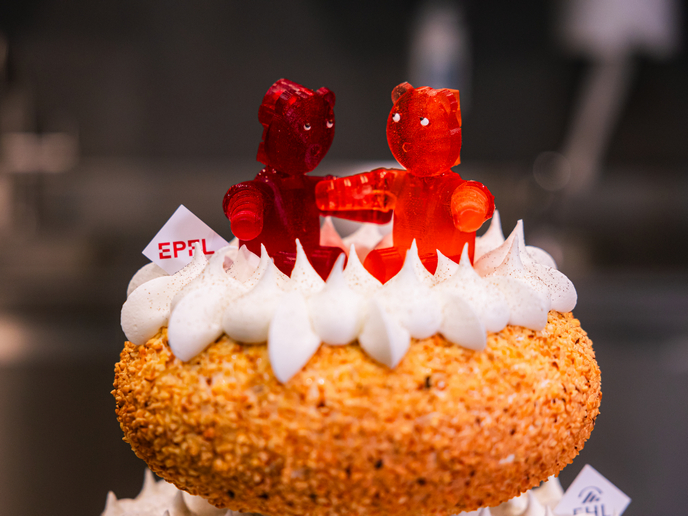
The project validated its approach through several demonstrators. Rescue RoboFood is a semi-edible drone for remote rescue and assistance in disaster situations. Its wings and body can be eaten, freeing up payload capacity to carry water. “Compared to a conventional drone of the same size, this allows more calories and hydration to reach people in emergency situations,” notes Floreano. For wildlife preservation and animal farming welfare, the team developed edible aquatic robots(opens in new window) – essentially fish food pellets that move on the water surface like natural prey. This motion could attract fish more effectively, improving feeding efficiency and reducing waste and water pollution caused by uneaten feed. As for robotic food for humans, ROBOFOOD focused on novel gastronomic experiences. At the 2025 World Expo in Osaka, Japan, the team presented RoboCake(opens in new window), a cake with edible chocolate batteries powering candle lights and robotic gelatine bears that dance and hug each other. Alongside the main demonstrators, ROBOFOOD delivered additional technological advances. These include small edible robots capable of jumping, an eco-conscious, edible soft actuator and the first rechargeable edible battery(opens in new window), developed in collaboration with the ERC-funded ELFO project by Mario Caironi at the Italian Institute of Technology. The team sees a broad range of future applications. “ROBOFOOD paves the way for a new generation of robots that could be mass-released in nature for environmental monitoring or for delivering nutrition to animals,” states Floreano. In the longer term, the technologies could also enable edible systems for gastrointestinal inspection, pending further research and medical collaborations.