What the Last Interglacial warm period can tell us about future coasts

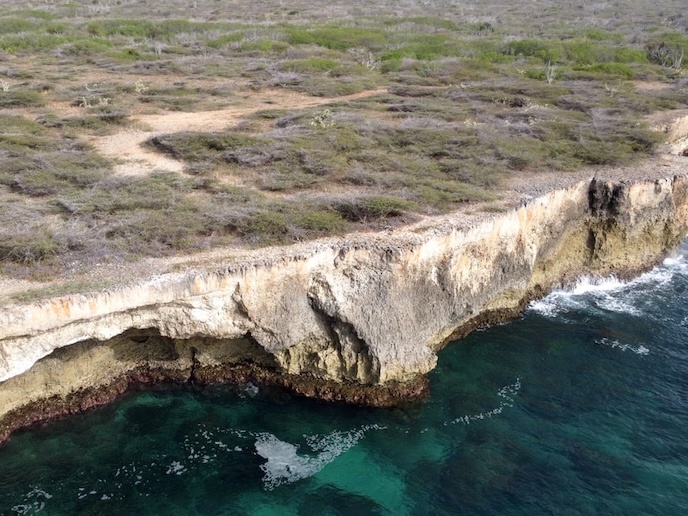
Interglacials are periods that were warmer than the pre-industrial, and can offer researchers the opportunity to model future climates by mapping similarities. The Last Interglacial (LIG) was a warm period in Earth’s history, roughly 130 000 to 115 000 years ago. During the period, both global and polar temperatures were higher that the pre-industrial, and ice sheets were smaller than today. Some studies show that waves may have been more intense, in certain coastal areas. Understanding coastal processes in this warm period can shine a light on the future of the world’s ice sheets and coastlines under warmer climatic conditions. The ability to extrapolate future models based on the properties of the LIG makes this a very studied period when it comes to the field of costal dynamics. “There are three pressing questions on the future of our coasts: Will storms be stronger in the future, how fast will sea levels rise and by how much? These factors have a direct impact on our coastlines and the people living there,” explains Alessio Rovere, professor in the Department of Environmental Sciences, Informatics and Statistics at Ca’ Foscari University of Venice(opens in new window) in Italy. Rovere launched the WARMCOASTS(opens in new window) projects to examine these further.
Multiple tools to establish characteristics of palaeo shorelines
To get global insight into these questions, the project set up an open access database(opens in new window), called the World Atlas of Last Interglacial Shorelines (WALIS). This is a global collection of published geological evidence of LIG coastal landforms and deposits. Scientists can use this tool to reconstruct ancient coastlines and better understand ancient sea levels during this past warmer period. The team also did fieldwork in different areas of the world, to gather geological evidence of past high seas and storm patterns. In Florida, they used ground penetrating radar (GPR), an instrument which employs electromagnetic waves to reveal what is under the surface. This allowed the team to map ancient beach structures, and reconstruct patterns of beach progradation, which connects to rates of sea-level change. The geological data collected in the project span Argentina, Aruba, Brazil, Cape Verde, Italy, Madagascar and the United States. This ensemble of evidence, merged with different types of mathematical modelling, allowed the team to better understand how coastlines change over time, throughout a warmer climate. “When you are in the field and find the perfect spot where to sample or to do your GPR profile, a sense of joy kicks in,” says Rovere. “And it comes with a humbling feeling, as if the planet is allowing you to peek into one of his closely guarded secrets.”
What palaeo shorelines reveal about the impact of warmer climates
“For a long time, we thought that Last Interglacial sea levels were 5-10 metres higher than today. During the project lifetime, both our team and others independently, have suggested that it may have been slightly lower than that, about 2-4 metres,” Rovere notes. “However, if we think that even 1 metre of sea-level rise is potentially catastrophic, it is quite relevant to know that worse happened before and can happen again.” The team also found evidence that sea level during this long period might have oscillated. This relates to the sensitivity of ice to slight warming change or may be dependent on local conditions in the areas they worked on. However, one potential reason for such oscillations is that Greenland and Antarctica melted out of sync, therefore leaving us to wonder: Will they do it again in a warmer future? And will more powerful waves be hitting our coastlines? Finding geological evidence of stronger, or more frequent, LIG storms is harder than finding sea-level indicators, but the project managed to develop several field/modelling strategies to investigate this question, some of them straight from the playbook of coastal engineers, such as wave models. These may be useful to those who will try to tackle this question in the future. “This project, which was funded by the European Research Council(opens in new window), tried to answer global questions working in synergy with collaborators from a wide range of countries and disciplines. One of the most thrilling aspects of the project was the way several colleagues partnered up with the project team and used their skills to further a common goal,” says Rovere.