The apocalypse is getting nearer, warn scientists

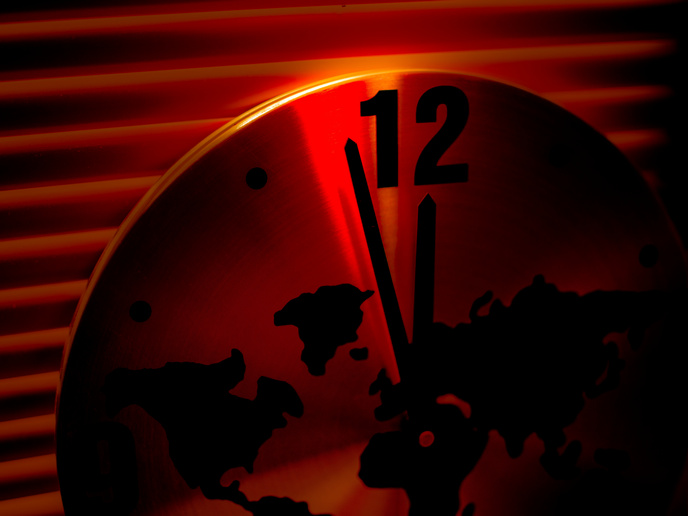
On 27 January, the Doomsday Clock(opens in new window) was set at 85 seconds to midnight. This is the closest it has ever been to midnight in its history. Exactly four years to the day, we introduced the symbolic Doomsday Clock in this space. Back then, it was stuck at 100 seconds to midnight. Ah, what good times those were.
Tick-tock, tick-…
Now, at 85 seconds, it’s down from 89 seconds in 2025. This is the third time that the iconic clock has been moved closer to midnight in the past five years. In 1991, the hand was set to 17 minutes to midnight. This is the year the hands set farthest from midnight thanks to the end of the Cold War. The Bulletin of the Atomic Scientists’ Science and Security Board (SASB) created the clock in 1947 during the Cold War tensions and sets it every year. It calls for urgent steps to be taken to limit nuclear arsenals, produce global guidelines on AI use and establish multilateral agreements to deal with biological threats around the world. “Of course, the Doomsday Clock is about global risks, and what we have seen is a global failure in leadership,” the Bulletin’s president and CEO Alexandra Bell told ‘Reuters’(opens in new window). “No matter the government, a shift towards neo-imperialism and an Orwellian approach to governance will only serve to push the clock toward midnight.” The nuclear policy expert explained the thinking behind this year’s change to ‘CNN’(opens in new window). “Humanity has not made sufficient progress on the existential risks that endanger us all. The Doomsday Clock is a tool for communicating how close we are to destroying the world with technologies of our own making. The risks we face from nuclear weapons, climate change and disruptive technologies are all growing. Every second counts and we are running out of time. It is a hard truth, but this is our reality.” “Rather than heed this warning, major countries became even more aggressive, adversarial and nationalistic,” added SASB chair Daniel Holz, professor at the University of Chicago. “Conflicts intensified in 2025 with multiple military operations involving nuclear-armed states. ... For the first time in over half a century, there will be nothing preventing a runaway nuclear arms race.”
What happens when the clock strikes midnight?
Thankfully, the Doomsday Clock has never hit midnight. “When the clock is at midnight, that means there’s been some sort of nuclear exchange or catastrophic climate change that’s wiped out humanity,” commented Rachel Bronson, former Bulletin president and CEO, who is now a senior adviser. “We never really want to get there, and we won’t know it when we do.” However, it’s not all doom and gloom. “We at the Bulletin believe that because humans created these threats, we can reduce them,” she added. “But doing so is not easy, nor has it ever been. And it requires serious work and global engagement at all levels of society.”