



Technological advances put a new spin on nuclear magnetic resonance

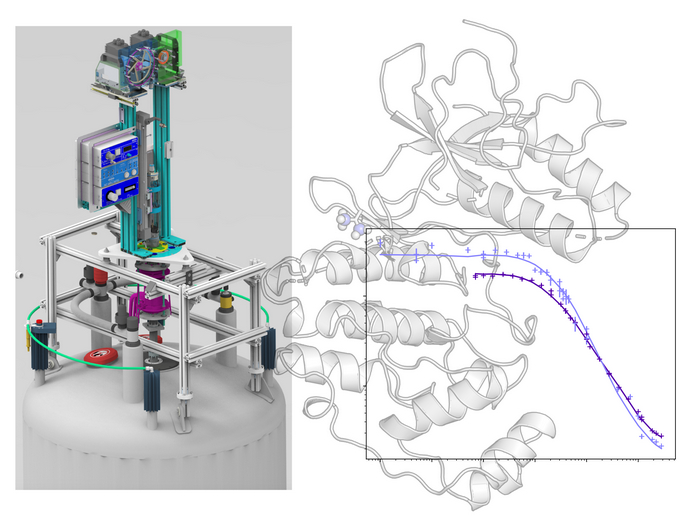
The bedrock of every conceivable substance is its molecular structure. Identifying the dynamics of matter at the atomic scale is necessary for understanding and improving the properties of matter. The EU-funded HIRES-MULTIDYN(opens in new window) project developed new instruments, methods and theoretical frameworks to advance scientific research, drug development, and materials science applications across multiple fields.
Some nuts and bolts of nuclear magnetic resonance
A powerful analytical technique, nuclear magnetic resonance (NMR)(opens in new window) is used to examine the structure and interaction of molecules. NMR is based on the behaviour of atomic nuclei when exposed to a strong magnetic field. This non-destructive technique has applications in chemistry, biology, medicine, pharmacology, nutrition and energy. In fact, since NMR can be used to examine any material, its applications are virtually limitless. The most well-known application of NMR is magnetic resonance imaging (MRI). MRI machines, which are found in medical facilities around the world, produce detailed images of internal organs and tissue. They use powerful magnets, about 30 000 times stronger than the Earth’s magnetic field, to elicit responses from atomic nuclei that are then translated into diagnostic images.
Introducing ultrafast high-resolution relaxometry
As powerful as NMR is, it provides limited information on the multiscale dynamics of complex systems. Relaxation is the process through which the nuclear spins affected by the magnetic field return to equilibrium. Measuring relaxation rates gives indirect access to molecular motions, but because relaxation is sensitive to motions on timescales inversely proportional to the magnetic field, accessing slower motions requires measuring relaxation at lower magnetic fields, which is incompatible with sensitive high-resolution NMR. To address this challenge, HIRES-MULTIDYN brought together a team of leading experts in NMR methods, instrument development, and the theoretical foundations of molecular dynamics. The project’s solution is called ultrafast high-resolution relaxometry (UHRR). A ground-breaking technology, it can determine the dynamics of complex systems at timescales ranging from picoseconds to microseconds. The project’s solution required exceptional conditions in a very controlled system. As project coordinator Fabien Ferrage shares: “To design our prototype, we needed to move a sample very fast, at 100 km per hour, in a highly controlled environment. We also need to add a series of other magnets right above the strong magnet for high-field NMR, including a magnet able to change its field by up to a factor 10 000 in about 1 millisecond.”
Opening new avenues for research and applications
There were many challenges along the way to developing the instruments, methods, and theoretical framework that support the HIRES-MULTIDYN solution, but the efforts of the project team were successful thanks to the dedication of all partners. The UHRR prototype has been tested in a number of proof-of-concept applications on complex systems, including proteins, liquid foods(opens in new window) and bodily fluids. Future applications of this technological breakthrough are far-reaching. “We have used this prototype to determine motions in a series of systems: to quantify motions important for drug-binding in a protein kinase, to identify how a small molecule binds to a drug target, to understand motions in liquid food like olive oil, and in ionic liquids that can be used in batteries,” Ferrage explains. Results are promising. With new conceptual frameworks, methods and instruments developed by world leaders in the field of NMR spectroscopy, UHRR is poised to introduce a new level of understanding in chemical, biological, and materials science.


