



Prototype reactor combines microbes, minerals, and AI to remove CO2

Europe needs to act quickly on reducing or eliminating carbon emissions, especially CO2. However, existing technology cannot always prevent this greenhouse gas from being released. For sources of pollution arising from numerous activities, such as transport, agriculture, and household energy use, carbon capture and storage (CCS) – a promising solution to cut CO2 emissions – is not an option.
Potential game-changer for removing CO2
Traditional CCS solutions are economically viable only at very large scales, where centralised capture and geological storage can justify the high capital and transport costs. The EU-funded BAM(opens in new window) project addressed this gap by investigating a technology that can operate independently at multiple local sites without huge energy demands, while delivering permanent CO2 storage. The BAM initiative sought to develop a novel technology that uses microbes and other living organisms to help rocks naturally absorb and remove CO2 from the air more effectively, preferably with the use of waste minerals. “In this way, we intended to achieve low-energy carbon sequestration,” states Ivan Janssens, professor at the University of Antwerp, Belgium, who coordinated the project. Another benefit is that the process produces an additive that improves soil quality while removing more CO2 from the atmosphere than it creates during its production and use, as well as a liquid to keep soil and ocean waters from becoming more acidic. It offers a technological solution for the many small-scale CO2 emitters scattered across a wide area. “As the cost of emitting CO2 is expected to rise in the coming decades, the demand for flexible, modular techniques capable of efficiently reducing emissions from distributed sources is increasing,” explains Janssens. “A locally deployable technology for efficient CO2 removal, without the need for investment in large-scale infrastructure, is therefore required.”
Completely novel approach to CO2 removal technology
BAM demonstrated that silicate weathering – a natural chemical process where rocks absorb CO2 from the air over time – can be accelerated under normal, everyday reactor conditions. A key insight from this work was that controlling conditions such as pH, flow, and mixing are essential to ensure CO2 uptake is not only efficient, but also sustainable and robust. This effect had a larger impact than the help provided by the microbes or other living organisms. The core innovation centred on the development of a hybrid geochemical-machine learning model. By integrating real-time sensor data, this model automatically adjusts the reactor for maximum efficiency. As a result, it overcomes current limitations. These mainly include CO2 or reactants that encounter difficulties moving to where reactions take place and newly-formed minerals that block surfaces or trap materials, stopping further reactions.
Towards a market-ready reactor
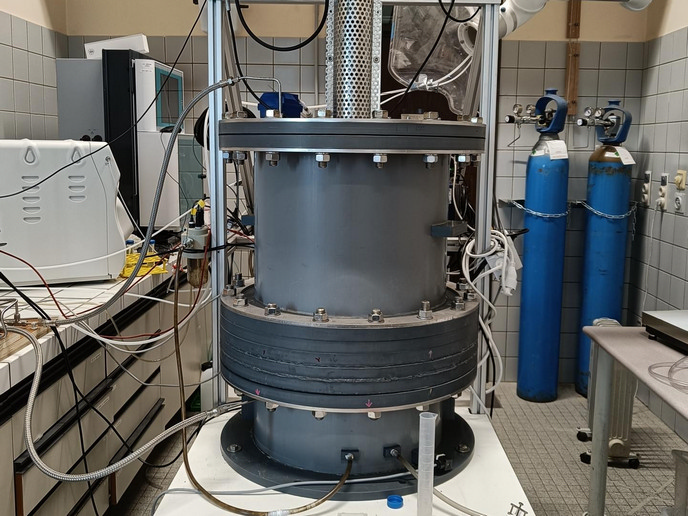
Although BAM has not yet delivered a reactor that is commercially available, it did gain considerable new knowledge on how to make rocks break down and react much faster while using very little energy. “In the future, the current prototype reactor could be upgraded with a centralised, fully automated control and monitoring system that connects sensors and actuators for water replacement, irrigation, mixing, and chelator dosing that helps reactions such as weathering or CO2 uptake proceed faster,” concludes Janssens. “This upgrade will enable uninterrupted operation and generate high-quality data to calibrate and validate the hybrid model.”