A plug-and-play standard for space systems

Although having a single interface capable of connecting with multiple space devices sounds practical, it has not yet been accomplished. Each standard interface still ‘speaks its own language’. The EU-funded SPACE USB(opens in new window) project changed that, breaking down barriers to a standard plug design for interconnecting space systems. It unveiled a single interface prototype demonstrating full electrical and mechanical compatibility with three major European spacecraft service interfaces – HOTDOCK, SIROM and iSSI – removing the human from the loop for future connections in orbit. This was achieved mainly by fostering collaboration between competing space engineering companies and urging them to make slight compromises to their standard interfaces to successfully adapt to the SPACE USB solution.
Bridging the gap between competitors
“Partnering with three leading European manufacturers – SENER (Spain), Space Application Services (Belgium) and iBOSS (Germany) gave us the strong foundation we needed to push forward innovation in system interconnects and create a unified system,” notes project coordinator Raphael Boissonnade. This partnership required a major mindset shift. “Initially, we had to motivate these partner companies, which are competitors outside the project, to collaborate towards a shared vision,” adds Boissonnade. Through intense effort and step-by-step progress, the project leaders succeeded in emphasising the importance of teamwork and aligning them with the project goals.
Interoperability challenges
A main challenge was defining what a system interconnect truly is and figuring out how to move towards standardisation as each system interconnect is unique and completely incompatible with others. The team then recognised that forcing all systems to fully align with the envisioned SPACE USB solution would create difficulties. “To this end, we asked partners to privately rank the device functionalities they considered most important and did not want to change,” outlines project member Matisse Briand. “Through careful negotiation and compromise – for example, finding a balance when one partner prioritised a functionality that another considered less important – we found common ground without forcing any company to entirely change the ‘DNA’ – core characteristics – of their existing products.” Another major challenge was symmetry. The original device interfaces of the partner companies varied, featuring 90-degree and 120-degree symmetries. The coordinator explains that for mechanical interconnection with SPACE USB’s solution, Space Application Services accepted to modify their device to a 120-degree symmetry. This compromise allowed all three interfaces to converge into a single, standardised plug design.
A new era for in-orbit servicing
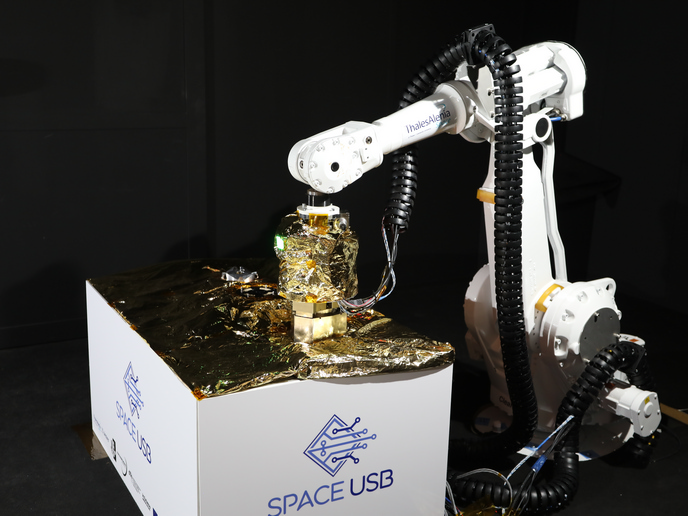
The SPACE USB solution is a universal, serial-standard space interface operating as a passive device. Once an active device locks in, it enables data/power exchange between systems. It is compact and works symmetrically. It can handle misalignments, transfer large loads and maintain reliability with backup systems to prevent failures. During validation, the team used a robotic arm and a simple LED patch to prove their solution worked as shown in this video(opens in new window). Prototype testing pushed the team to their limits. Supply chain delays compressed the original testing schedule from one month down to just one week per partner. Despite these tight deadlines, the team successfully validated their solution. “While SPACE USB is just the first step, it lays the groundwork for further initiatives to promote interoperability in space. Just as the USB plug evolved on Earth over the last 30 years, this interface will grow to meet the future needs of space exploration, democratising orbital services for everyone,” concludes Boissonnade. For more information about the activities leading up to the final prototype, refer to this CORDIS news article.