



Novel gamma-ray light sources leveraging channelling crystalline undulator radiation


Modern X-ray free electron lasers (XFELs) – powerful tools that generate coherent and ultra-short pulses of X-rays of approximately one angstrom wavelength – have very high brilliance. This enables, among other applications, the non-destructive imaging of biomolecules. However, reducing their achievable wavelength to the gamma radiation realm while maintaining or increasing their intensity is challenging. With the support of the Marie Sklodowska-Curie Actions (MSCA) programme, the N-LIGHT(opens in new window) project sought to overcome the wavelength-intensity trade-off with tuneable gamma-ray crystal-based light sources (CLSs) capable of sub-angstrom-wavelength and ultrahigh-brilliance. Exciting potential applications abound in fields including fundamental science, industry, biology and medicine.
Channelling through crystals
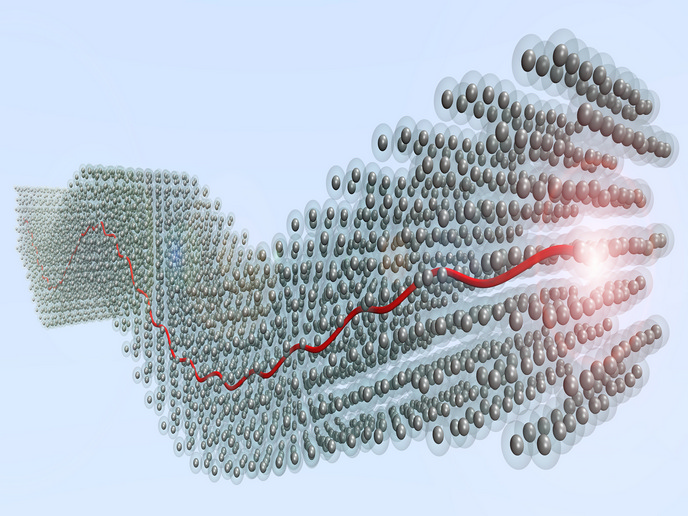
Advanced light sources such as XFELs rely on large magnetic undulators to create coherent light. N-LIGHT implemented a radical approach – the use of crystalline electromagnetic electrostatic fields, which are orders of magnitude stronger than the fields achievable with superconducting magnets. The collective electrostatic field of the crystal atoms is used to control the movement of charged particles – typically electrons or positrons – in the crystal along crystallographic planes, a phenomenon known as ‘channelling’. This leads to the transverse oscillation of the particles and the emission of channelling radiation. According to Andrey V. Solov’yov of the MBN Research Center(opens in new window), N-LIGHT coordinator: “In a periodically bent crystal, additional emission of ‘crystalline undulator radiation’ arises from the particle’s upward and downward movement along the bent planes.” These powerful crystalline electrostatic fields steer ultra-relativistic particles, which are particles moving at nearly the speed of light. They do so more effectively than the most advanced magnets, enabling dramatically miniaturised and less expensive light sources compared to conventional ones.
Pioneering theoretical, computational and experimental advances
Based on theoretical developments relating the bending profile of crystal planes to the variation in dopant atom concentration, numerical simulations showed that channelling efficiency and the intensity of crystalline undulator radiation depend strongly on beam orientation relative to the bent channel profile at the crystal entrance. Simulations also demonstrated that the radiation intensity of CLSs could outperform current state-of-the-art gamma-ray light sources. Cutting-edge computational tools enabled simulation of single-particle propagation behaviour through a crystal and prediction of radiation properties. A comprehensive mapping of operational parameters for acoustically driven crystalline undulators established practical ranges relevant to both the MAMI accelerator(opens in new window) and the accelerators at the European Council for Nuclear Research(opens in new window) (CERN)).“Molecular dynamics simulations characterised – for the first time – structural changes induced by boron doping in diamond and germanium doping in silicon,” notes MSCA fellow Andrei Korol. These insights were translated into tangible experimental milestones. Two crystalline undulators were manufactured – one via gradient boron doping of diamond, the other via tensile film deposition on silicon – and tested at MAMI and CERN respectively. According to Solov’yov and Korol: “The experimental campaign yielded two landmark firsts in a single experiment: the first direct observation of crystalline undulator radiation from a boron-doped diamond crystal exposed to an electron beam, and the first observation of positron channelling (both at MAMI).”
Bright future for gamma-ray crystal-based light sources
Construction of CLSs requires a long and challenging pipeline: crystal sample preparation, design and manipulation of particle beams, and detection and characterisation of radiation, all supported by theoretical analysis and advanced computational modelling. N-LIGHT has traversed this path in its entirety. Moving to industrialisation will take time. However, if one draws inspiration from historical parallels with synchrotrons, optical lasers, laser Compton light sources and XFELs, these radical gamma-ray light sources have the potential to launch multi-billion-euro industries with far-reaching impact for societal good.