Robots taking the lead in spacecraft assembly beyond Earth

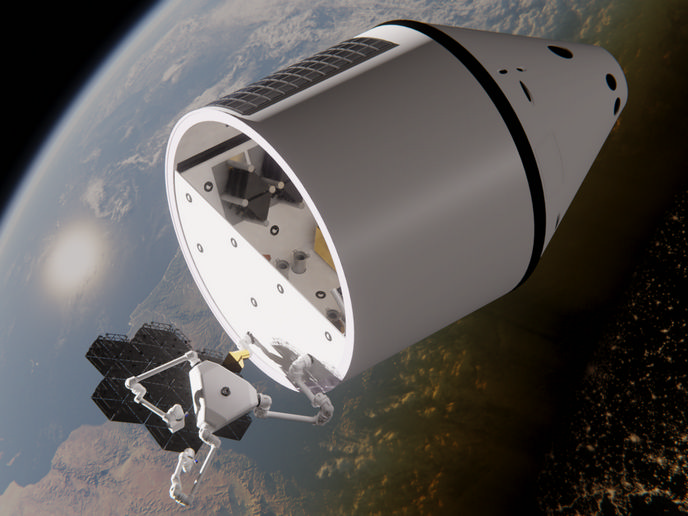
Space exploration has always been constrained by what can be built on Earth and launched into orbit. But what if we could bypass these constraints and build directly in space? This is the promise of in-space assembly and manufacturing (ISAM)(opens in new window), a groundbreaking approach that allows spacecraft to be assembled and maintained in orbit. The EU-funded EU-RISE(opens in new window) project set out to make this vision real, tackling the technical and strategic challenges. Before diving into the essence of robotics, EU-RISE took a step back to understand the bigger picture – considering what the future of ISAM looks like, exploring what opportunities exist and identifying where the roadblocks might be. Through a detailed market analysis and consultations with industry experts, the project identified two potential future scenarios. “The near-term scenario envisions spacecraft returning to Earth, while the long-term scenario focuses on modular, in-orbit systems,” explains Marko Jankovic, EU-RISE project coordinator and robotic architect at Airbus Defence and Space. “Both relying on autonomous robotic systems for assembly and servicing, the scenarios provided a roadmap to ensure that every technological development is aligned with real-world needs.”
Building the tools
With a clear understanding of the market, EU-RISE, with Airbus Defence and Space as a key project partner, turned its focus to developing the tools needed to make ISAM possible. It refined existing technologies such as the Versatile In-Space and Planetary Arm (VISPA) and the Standard Interface for Robotic Manipulation(opens in new window) (SIROM), which have been in development since 2016, as well as the robotic system control framework and the ground console. New innovations such as a system using a SIROM for Tool Exchange and the Multi-Purpose Tool offered robots the flexibility to adapt to different tasks. A gravity offloading system simulating the weightlessness of space ensured that these technologies could be tested on Earth in a controlled environment.
Proving the concept
The EU-RISE project brought all technologies together in a hardware-in-the-loop demonstrator that mimicked real mission conditions. “Results were groundbreaking, proving that the robotic system can perform complex ISAM operations. Robots successfully assembled an antenna array and a boom. The system was also tested to potentially perform satellite refuelling,” notes Jankovic. Recognising that innovation does not happen in isolation, EU-RISE developed an open-source strategy to foster collaboration across the space industry. By creating a framework for licensing, cost management and best practices, researchers, small businesses and large corporations will have a blueprint for working together to advance ISAM.
A new era for Europe in space
Project advancements pave the way for a more sustainable space industry. Modular systems can be repaired, upgraded and reused, thereby reducing waste and minimising space debris. “Project outcomes are crucial because they represent a shift from single-purpose spacecraft to modular assets that can be robotically serviced, manufactured and assembled in space. This boosts Europe’s ability to offer competitive on-orbit servicing for existing satellites and ISAM for new assets, making Europe a leader in the global space industry,” highlights Jankovic. The successful technologies will be further developed and used in upcoming European in-space operations and services pilot missions. This effort supports Europe’s strategy for space infrastructure, helping to build a new space economy, protect space assets and ensure Europe’s independent access to space.