How E. coli invades and colonises healthy human gut microbiotas

The gut hosts the largest microbial population in the human body – known as the gut microbiota, with significant health implications. For example, a healthy gut microbiota can confer resistance against harmful bacteria, losing that benefit if the microbiota is disrupted. However, colonisation still happens in healthy gut conditions. “The precise mechanisms underlying this are still unknown, complicated by the fact that each person’s specific gut microbiota can potentially lead to unique responses,” says Hugo Barreto, principal researcher for the MICROINVADER project, set up to understand how individual variation influences bacterial colonisation dynamics.
In vitro and in vivo human gut microbiota testing
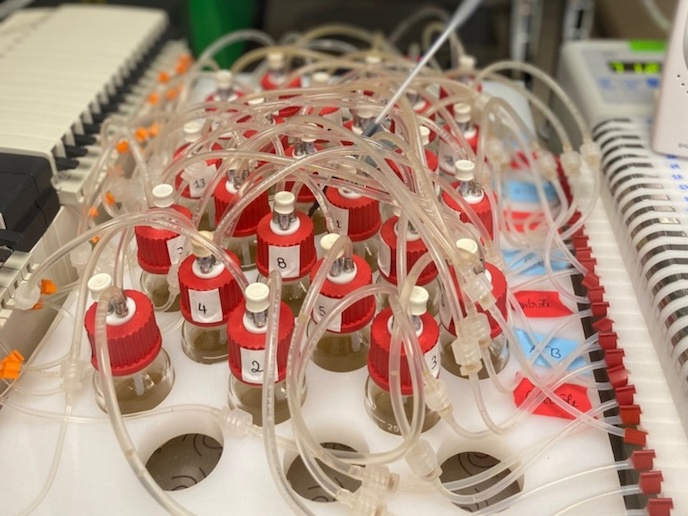
Escherichia coli is a bacterium that colonises many environments, including the human gut. Genetically highly diverse, when colonising the human gut it is considered a ‘commensal’ – coexisting without causing harm to the host. But it can also prove pathogenic, causing around 1 million deaths per year(opens in new window). In humans, it is known to rapidly evolve, and even in healthy conditions invading strains of E. coli constantly replace the resident ones – known as strain replacement. “As a model organism, E. coli can be genetically manipulated, enabling the introduction of ‘molecular barcodes’ or fingerprints to distinct strains of E. coli, previously isolated from humans,” explains Barreto, from the French National Institute of Health and Medical Research(opens in new window), the project host. “As each has a different barcode, sequencing can identify those E. coli natural isolates able to invade and colonise the human gut microbiota.” To study this process in vitro, the Marie Skłodowska-Curie Actions(opens in new window) project selected 16 microbiotas (from the NutriNet-Santé(opens in new window) cohort), cultivating them in a MiniBioReactor (MBRA) array within an anaerobic chamber, for up to two weeks. “This system maintains the microbial community associated with each donor gut microbiota while allowing precise manipulations – such as introducing natural isolates of E. coli and sampling the community – without the confounding effects of a live host’s changing behaviour,” adds Barreto. After a few days of acclimatisation, a barcoded panel of 26 natural isolates of E. coli were introduced to the MBRA, with abundance and barcode dynamics monitored over time. Crucially, the gut microbiotas selected already contain a resident E. coli strain(s), so that strain replacement or co-colonisation could be tested in real time. To characterise the evolutionary dynamics of the successful E. coli invaders, axenic mice(opens in new window) – devoid of any bacteria – were colonised with eight human gut microbiotas selected from the MBRA experiment, and monitored over two months.
Characterising invasion and colonisation success
The team observed that the invasion and colonisation success of E. coli differed across human gut microbiotas, by up to three orders of magnitude. Furthermore, the dominant E. coli strain after invasion was donor dependent. “While this is partly explained by the diversity of human gut microbiota and the presence of genetic subdivisions of E. coli within the human gut microbiota, we observed the rapid evolution of the dominant invading strain altering these dynamics,” notes Barreto. Meanwhile, with analysis still ongoing, the mouse model work led to the observation that certain human gut microbiota restrict the abundance of E. coli by two orders of magnitude. “The most surprising observation was that the resident E. coli strains were replaced across all the human gut microbiotas tested. Previously, colonisation was tested using a single strain and mostly failed, while we introduced over 20 strains simultaneously. This suggests that strain replacement is a consequence of both the invading bacteria diversity and the composition of human gut microbiota,” remarks Barreto. Understanding the mechanisms governing strain replacement in healthy conditions could lead to therapies that tweak the human gut microbiota into better maintaining health, such as faecal gut microbiota transplants.