A new approach to assessing rockfall risks

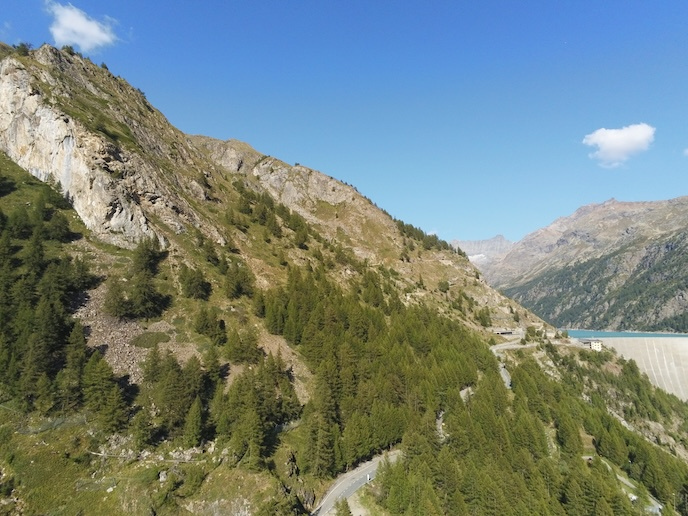
Rising temperatures, melting permafrost and extreme weather are destabilising slopes and making rockfalls an increasingly frequent event and growing risk to the many people living and working in the mountains. “A rockfall’s impact can cause fatalities and injuries, disrupt transportation networks, damage buildings and utilities and generate substantial financial losses,” says Maddalena Marchelli(opens in new window), a researcher at the Polytechnic University of Turin(opens in new window). With the support of the EU-funded RIDETHERISK(opens in new window) project, Marchelli improved how we understand and predict rockfall hazards. “RIDETHERISK addresses questions related to rock fragmentation and risk assessment, with the aim of providing tools that can support real-world decision-making,” she explains. The project received support from the Marie Skłodowska-Curie Actions(opens in new window) programme.
A more realistic representation of rockfall processes
One of the tools the project provided is a physically based rockfall propagation model and a related RockFRAG code. Together, these tools account for fragmentation upon impact and rock-mass quality and block shape. They were calibrated via a large experimental campaign and validated in real-world cases. “When a falling rock breaks into multiple fragments, the resulting hazard can change dramatically, affecting the area exposed to impact and the potential damage caused,” notes Marchelli. Despite this risk, Marchelli says that fragmentation is often neglected or oversimplified in current engineering practice. “While large efforts have been devoted to improving rockfall hazard assessment, risk evaluations are often affected by substantial uncertainties because fragmentation processes and their consequences are not adequately considered,” she adds. “As a result, the actual intensity, frequency and spatial distribution of impacts can be underestimated or misrepresented.” By simulating the generation and subsequent trajectories of rock fragments, the RIDETHERISK model provides a more realistic representation of rockfall processes. In doing so, it enables a more accurate quantification of rockfall hazard and thus improves the ability to assess the associated risk and the evaluation of mitigation measures.
Assessing the rockfall risk
In addition to modelling the actual impact of a rockfall, the project developed formulations and methodologies for assessing risk at a site, accounting for all possible events, their probability and resulting damage. Unlike traditional approaches that often consider a limited number of scenarios, the RIDETHERISK tool incorporates the full range of possible rockfall events and their temporal variability, accounting for the evolution of hazard, vulnerability and exposure conditions over time. According to Marchelli, this integration allows for the quantification of both social and economic risks while explicitly considering uncertainties and multiple hazard scenarios. “The resulting risk estimates are more comprehensive and better suited to supporting risk-informed decision-making and the design of effective mitigation strategies,” she says. The methodology was tested in real-world environments, including transportation corridors in alpine regions and in open-pit mining operations.
Better risk assessments for better-informed decision-making
By improving the representation of fragmentation processes and developing a comprehensive quantitative risk assessment framework, RIDETHERISK delivered a more realistic way of evaluating the potential consequences of rockfall events. But the project’s most important outcome is improving the safety of people, workers and infrastructure exposed to those rockfall events. “Better risk assessments lead to better-informed decisions, more effective mitigation measures and a more efficient allocation of resources – all of which contribute to reducing risk and enhancing resilience,” concludes Marchelli.