Real-time, microbiome-focused decision support tool targets food waste and safety


Food quality and safety monitoring has traditionally relied on retrospective culture-based testing, fixed shelf-life labels and fragmented traceability records. Food is often discarded earlier than necessary and spoilage is detected only after it has begun. Furthermore, current approaches rarely capture the complexity of the food microbiome or its functional interactions. Unlike previous approaches investigating the application of individual proactive technologies, the EU-funded FOODGUARD(opens in new window) project combined multiple advanced technologies into one system. The Intelligent FoodGuard Management System (iFGMS) enables real-time monitoring of food quality, prediction of remaining shelf life, dynamic risk assessment and transparent information sharing across the food supply chain.
Biopreservatives, smart sensors, AI and blockchain technology
“The iFGMS combines multiomics (metagenomics, metabolomics and metatranscriptomics), non-invasive IoT sensing via infrared spectroscopies and mass spectrometry imaging, AI-driven predictive modelling and blockchain-enabled traceability,” explains project coordinator George-John Nychas of the Agricultural University of Athens(opens in new window). It provides secure, end-to-end food traceability and dynamic, real-time shelf life management with data shared across the food supply chain. Field users access IoT information directly through the iFGMS app while its consumer interface presents product history and sustainability information. Alongside this digital decision support system, FOODGUARD applied biopreservatives – bacteria that produce metabolites inhibiting spoilage and pathogen growth – as healthier, safer alternatives to chemicals such as chlorine. The project tested both conventional lactic acid bacteria and novel oregano essential oil.
Pilots test approaches across food groups
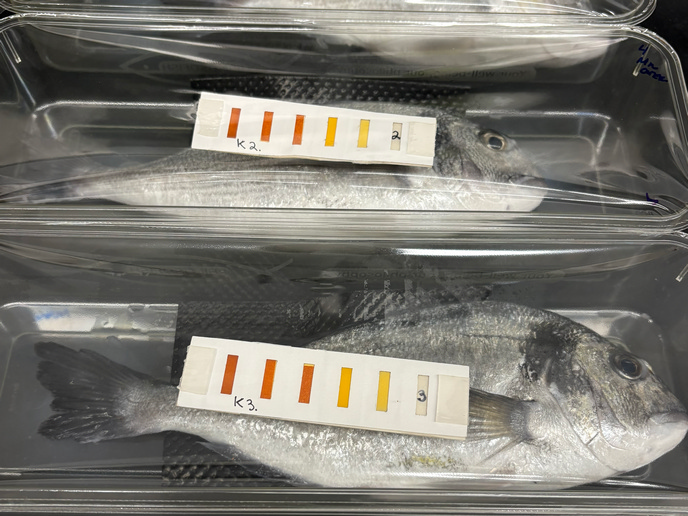
FOODGUARD tested its methods across four pilots covering ready-to-eat vegetables, sea bream, meat and feta cheese. The biopreservatives extended shelf life by one to four days across the different foods, delaying spoilage. Monitoring efficacy varied by food type. Fourier transform infrared spectroscopy and mass spectrometry imaging predicted spoilage with up to 92 % accuracy in fish and meat, showing that these matrices are well suited to rapid digital assessment. “Leafy vegetables proved more challenging. Their appearance was often unchanged despite stable or increasing populations of common harmful bacteria, suggesting that biopreservation can mask the presence of harmful bacteria in vegetables. Commercial scaling will require matrix-specific sensor calibration,” notes Nychas.
New digital tools and policy gaps
Beyond the iFGMS, the consortium built a publicly accessible, web-based microbial growth predictor tool. In addition to assessing compliance, it models growth, performs risk assessment from farm to fork and estimates shelf life, supporting food safety decisions across the sector. A traceability automation module links production, storage, transport and quality data to specific food batches, reducing manual work and improving traceability. An adapted CHIPSENSE sensor for rapid food condition assessment feeds data into the growth predictor and iFGMS. The project also flagged policy gaps. Considering dynamic microbial ecosystems rather than individual microorganisms will be necessary as food safety assessment evolves towards integrated health-economic-environmental risk assessment. FOODGUARD also spearheaded an EU whitepaper on fisheries’ traceability regulations, contributing to the ongoing implementation of the EU Fisheries Control Regulation(opens in new window) and its mandatory, fully digitised catch certification scheme. Despite disease outbreaks disrupting pilot activities in Greece, the consortium adapted its protocols, timelines and resources, and delivered on all its objectives. “Integrating deep biological insights from genomics with the real-time speed of spectroscopic sensors provides unprecedented detail and predictive power,” says Nychas. The project transforms food quality management from reactive, single species testing into proactive, data-driven decision-making based on the dynamic development of the food microbiome. It also promises less food waste, greater food safety and enhanced consumer trust across the food supply chain.