How green energy storage can drive renewables

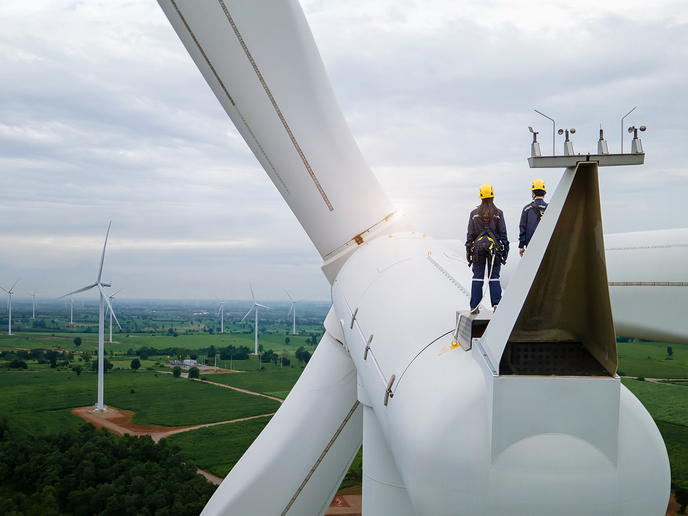
Renewable energy systems like wind and solar provide us with clean power from natural resources, reducing our dependence on polluting and often imported fossil fuels. These sources of renewable energy however are variable – dependent on sunshine or wind conditions – and production doesn’t always match demand.
Storage involving green hydrogen
“The green energy transition requires more than developing clean technologies,” notes AMBHER(opens in new window) project coordinator Angela Mary Thomas from Tecnalia(opens in new window) in Spain. “It also needs innovative storage solutions.” Green hydrogen storage is one of the ways to support this transition. Surplus renewable electricity can be converted into hydrogen through electrolysis, which can then be stored, transported and later used in fuel cells, transport or industrial processes. “The main challenge for green hydrogen storage is that hydrogen has a low volumetric energy density,” explains Thomas. “Storing it directly generally requires specialised materials or high-pressure vessels often at very low temperatures. Converting hydrogen into simple molecules like ammonia can make long-term storage easier, but conversion and recovery also involve energy losses and additional equipment.”
Hydrogen storage using MOFs and ammonia
The EU-funded AMBHER project sought to advance the development of these hydrogen storage technologies, both for short-term storage and long-term storage, and to eventually establish a basis for eventual commercialisation. For this, the project brought together a consortium of 16 partners from six countries, with areas of expertise ranging from applied materials science to largescale energy provision. For short-term storage, the team developed novel ultra-porous Metal Organic Frameworks (MOFs). MOFs are cage-like porous materials built with metal ions connected by organic molecules, on which hydrogen can attach itself. These MOFs can be integrated into newly designed storage vessels for transport applications. Long-term hydrogen storage involves the safe and sustainable production of ammonia. For this, new catalysts and membranes were developed, to be integrated into membrane reactors for process intensification. The focus was on achieving resource-efficient processing and low-cost material synthesis, to reduce material and energy requirements while supporting European industrial competitiveness. “In this way, we were able to advance complementary approaches to hydrogen storage across different timescales,” says Thomas. “This can contribute to more resilient, sustainable and secure raw-material value chains by strengthening European capabilities in the design and manufacture of advanced catalysts, membranes and nanoporous materials.”
A climate-neutral European energy system
The project was able to demonstrate the viability of the proposed storage solutions. AMBHER therefore represents a concrete step towards a secure, circular, and climate-neutral European energy system. It also provides a technological basis for subsequent industrial demonstration and commercial deployment. Several technical challenges regarding material development were identified during the implementation. AMBHER technology roadmap predicts that eventual commercialisation for both solutions would take from seven to 11 years, requiring continuous investment in novel material development - from lab scale to market. AMBHER technology developers are looking forward to exploit both storage solutions through patenting, industrial design and licensing agreements of the developed materials and processes. Direct industrial use of ammonia synthesis through integrated catalytic membrane reactor systems can also explored for licence agreement/technology transfer to ammonia producers and technology providers.