Innovative multi-metal joints open up new possibilities for 3D printing

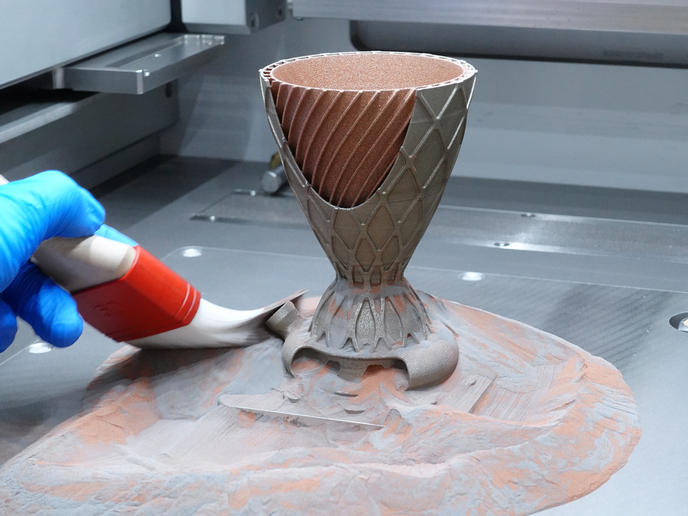
Metal additive manufacturing (AM), commonly known as 3D printing, has always faced a persistent challenge. It typically relies on a single material from start to finish. While uniform materials work well for basic parts, they often do not meet complex demands, such as balancing extreme heat resistance, flexibility and strength, all within a single component. Many high-performance alloys are prone to cracking during printing due to thermal induced stresses of the process. This problem becomes worse if two or more materials are combined in a single component through AM. Consequently, AM multi-materials were developed through costly trial and error. There were no design tools, no qualification standards and no way to recycle mixed metal powders. This need was especially clear in the automotive, aerospace and energy industries, where demands for lightweight, performance and efficiency are growing faster than mono-material AM components can keep up with.
Advancing multi-material AM
The EU-funded MADE-3D(opens in new window) project tackled this issue by developing efficient, sustainable and flexible production processes that meet the growing demand for complex components with specific properties. The project team built a set of novel multi-material joints that were tested and proven in real-life industrial settings. Rather than relying on trial and error, these joints are created using advanced computational modelling and machine learning. In a world first, MADE-3D successfully 3D printed nickel-titanium joints as a lightweight solution for rocket nozzles that can handle extreme heat while maintaining their structural strength. The researchers managed to fuse Inconel 718 and Ti6Al4V – two high-tech aerospace metals – without defects. The material combination was successfully trialled and validated using full-sized, real-world components. “This pair is among the most crack-prone in AM, and the result is considered a scientific novelty,” comments project coordinator Dennis Lehnert, research associate at Paderborn University in Germany. “A weight reduction of around 40 % compared to a mono-material nozzle has been achieved, which marks a significant milestone.” Weight makes all the difference. In aerospace and aeronautics, it determines how much fuel is burned and how many emissions are produced. In aviation, lighter components in engines and propulsion systems curb fuel consumption on every flight, which adds up to significant CO2 savings over an aircraft’s decades-long service life.
Aligning with EU sustainability and resilience goals
The technological innovations improve AM’s performance, reliability and sustainability, making them more appealing to industry. European competitiveness gets a major boost from lighter, stronger and more efficient components that reduce material waste and decrease the environmental impact of manufacturing. “MADE-3D shows that multi-material AM can make a direct contribution to the decarbonisation of air and space transport,” adds Lehnert. To this end, it supports European Green Deal and circular economy goals(opens in new window) by emphasising recycling and sustainability. The project also sets new standards in digital manufacturing, positioning the EU as a global leader in AM. “MADE-3D transformed multi-material metal 3D printing from an experimental, trial-and-error approach to a predictive engineering discipline,” concludes Lehnert. “It created a comprehensive framework that guides the development of new materials and components from computational alloy design and process optimisation through to design guidelines, qualification and recycling, thus enabling future multi-material applications to be realised faster, more reliably and with less experimental effort.”