Flexible tools anticipate, detect and respond to drinking water threats

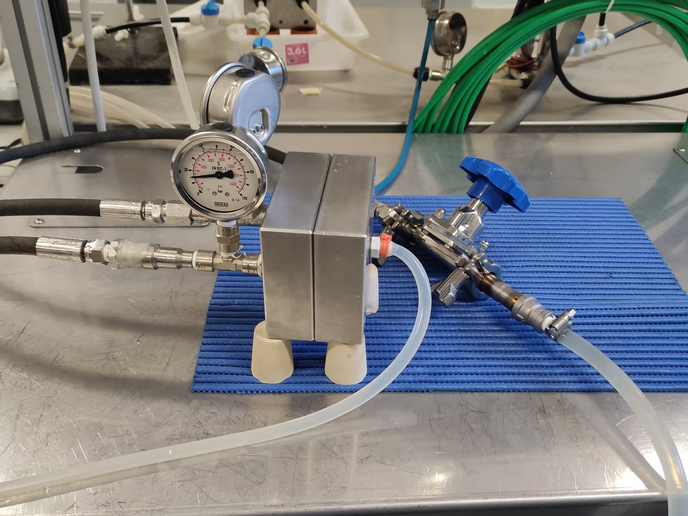
Almost all the EU’s freshwater comes from rivers, lakes and groundwater, much of which contains harmful industrial, pharmaceutical and agricultural residues, bacteria and microplastics. Climate change adds further pressure, as heavier storms and flooding wash more pollutants from land into water sources, alter contaminant concentrations and increase their mobilisation. Drinking water treatment plants, the last barrier before water reaches human consumption, often struggle to detect and remove such varied contaminants and risk the creation of toxic disinfection by-products (DBPs). The EU-funded NIAGARA(opens in new window) project set out to close this gap with modular tools that monitor, treat and predict the propagation of chemical, microbiological and plastic pollution at once to address climate-intensified contamination.
Multianalyte detection at low concentration
NIAGARA’s biosensor platform relies on nanophotonics to detect four different types of chemical pollutants in real time with a single assay, something no existing commercial system achieves. It dramatically reduces response time. The platform detects: bisphenol A (BPA), an endocrine disruptor found in plastic packaging; imazalil, a persistent agricultural fungicide; and ibuprofen and paracetamol, widely used pharmaceuticals. Polymerase chain reaction-based methods also enable the platform to detect the biological pollutant Helicobacter pylori (H. pylori), a bacterium found in sewage that causes peptic ulcers. It opens the door to detection of other waterborne pathogens as well. Since contaminants present at very low concentrations or in large volumes of water can be difficult to detect, NIAGARA developed two highly successful preconcentration units for chemicals and microorganisms. “These units enable the biosensors to detect ultra-low concentrations of chemicals and as few as 10 to 100 living pathogen cells, well below levels considered harmful to human health and undetectable by other commercial technologies,” notes project coordinator Carlos Fito López of ITENE(opens in new window). The project also built predictive models using smoothed-particle hydrodynamics(opens in new window) to forecast how contaminants spread through drinking water distribution networks. These models outperform current forecasting methods, supporting proactive rather than reactive contamination management.
Two independent treatment systems with expanded capabilities
The consortium developed two water treatment technologies. An immobilised-enzyme degradation system breaks down chemical pollutants – and, unexpectedly, microplastics – with high specificity while producing minimal DBPs. A second system uses photocatalytic oxidation and disinfection to degrade BPA, imazalil, ibuprofen and paracetamol while completely inactivating H. pylori. Exceptionally, it degrades existing DBPs and eliminates DBP precursors, producing significantly fewer harmful by-products compared to conventional chlorination. Water utilities welcomed the flexibility of modular deployment, enabling treatment that matched their contamination profiles and existing infrastructure. “Together, the two systems remove more than 70 % of total organic carbon, a broad measure of chemical pollution, and disinfect below detection limits for all four analytes,” Fito López explains.
Technology validation and policy shaping
Pilot-scale validation of selected monitoring and treatment technologies at an operational drinking water treatment plant in Valencia sets the stage for optimisation and commercialisation. A first policy brief drawing on an analysis of 27 relevant EU legislative and regulatory texts identifies opportunities to strengthen monitoring, regulatory coordination and technology uptake. The project’s findings are already reaching EU-level decision-makers through NIAGARA’s membership in the rapidly expanding ZeroPollution4Water Cluster(opens in new window), informing joint recommendations on preventing groundwater contamination against emerging risks. “The NIAGARA(opens in new window) project proves that a single system can simultaneously monitor, remove and predict the spread of multiple chemically diverse pollutants while eliminating DBPs,” concludes Fito López. It has the potential to transform how European water infrastructure anticipates, detects and responds to climate-amplified contamination threats, helping to strengthen the resilience of drinking water systems.