Edible lasers are invisible ‘barcodes’ that monitor food

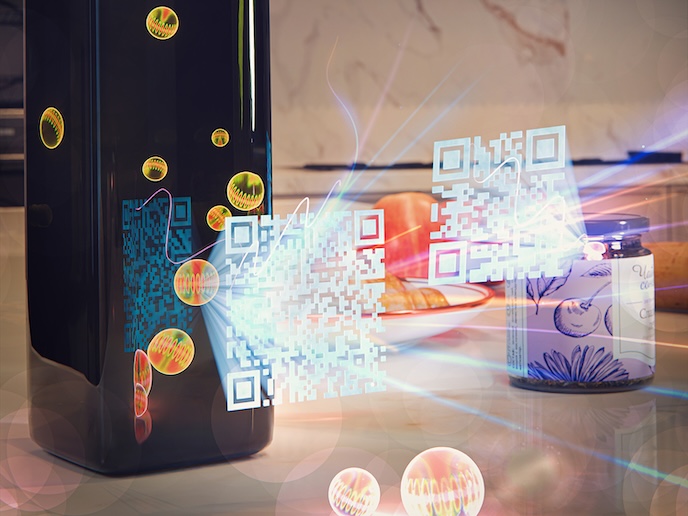
Miniature ‘devices’ that emit laser light can be embedded in food or pharmaceutical products, where they can act as unique barcodes that identify a product and help to detect counterfeits. They also act as sensors that show whether the product is still fresh, which could help reduce food waste. “It is possible to make extremely small lasers, a fraction of the thickness of human hair, in different forms. One form is microscopic spheres or beads,” according to EdibleLasers project coordinator Matjaž Humar(opens in new window), senior researcher at the Jožef Stefan Institute(opens in new window) in Ljubljana, and associate professor at the University of Ljubljana, Slovenia. “For the first time, we were able to make these very small lasers completely out of edible materials,” he says. These beads or droplets contain fluorescent material that amplifies the laser light. They can be safely embedded in foodstuffs and pharmaceuticals, without altering the nutritional value or taste, and are tamper-proof once they are embedded.
Like an internal barcode
When illuminated by external light, the embedded microlasers emit their own light with a well-defined colour or frequency. This precision allows researchers to encode information, such as an expiry date or batch number, similar to an optical barcode. “You can put it directly into the produce. So this can be used for products that don’t have packaging – like fruits, or before they are packaged, for example, to identify the origin,” Humar notes. They can also act as a sensor. “Any small change in the laser itself or the surrounding will change the output of the laser, so it’s really sensitive to the environment.”
Reliable read-out
The 18-month project, which was supported by the European Research Council(opens in new window), was able to show that edible lasers stay stable and readable for over a year. Using the microlasers as sensors, the researchers measured the pH of milk, which changes when milk turns sour. They also measured sugar concentration and the growth of some bacteria. “We can also detect whether sometime in the past the food or pharmaceuticals were stored at a too-high temperature,” Humar explains, noting this could affect freshness or drug efficacy.
The search for edible laser materials
Humar led the previous EU-funded Cell-Lasers project, which developed biocompatible microlasers implanted in cells and tissue for barcoding and sensing. “The change from biocompatible materials to completely edible materials required research into the right materials, given strict regulations for foodstuffs, such as permitted E numbers,” he says. “We went very precisely through the list of materials allowed for consumption and tested a lot of them.” Only a few materials worked well. The best were chlorophyll – the green pigment in plant leaves – and vitamin B2 (riboflavin). Both are highly fluorescent dyes that amplify the microlaser’s light. The project developed a number of microlasers for different products. They were tested on olive oil and honey, which are often targets of fraud. In an EU check(opens in new window) in 2021 and 2022, 46 % of the imported honey samples were suspected of being adulterated. “Olive oil is often mixed with cheaper oils,” Humar observes. “A barcode inside the product can confirm whether it is genuine.”
A compact laser reader
The project also developed a prototype detection device, using commercially available components, to measure the microlasers’ narrow frequencies in the lab. This requires a small spectrometer and a laser, like a laser pointer, to read the embedded microlaser signals. The next step is to validate the microlasers and the reader on high-value foods for extended periods outside the lab. A future aim is to develop a cheaper handheld device in-house, as sensitive off-the-shelf spectrometers can be expensive.