



Laser-welding: an innovative tool at robotics services

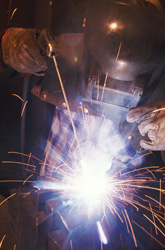
Laser welding is a common technique used by manufacturers for a variety of applications. Aerospace, transport and heavy reconstruction industry sectors, among others, use this technique especially in complex welded constructions in thick section steel. Some prominent features of laser-welded thick sections involve low heat input, minimal distortion, high joint accuracy and design flexibility and low cost. These fabrications are easy to handle and control, hence they are widely used in fully automated procedures. Laser-welded constructions are typical for the primary load-carrying structures in transport equipment; however, their production requires further optimisation. For this purpose lead-time, cost, quality and fuel consumption need to be optimised against durability, structural integrity and fatigue resistance of welded materials. Research partners joined forces to develop state-of-the-art welding techniques for innovative materials towards increasing cost effectiveness in transport equipment. The fabricated structures were tested for reliability, reproducibility and autonomy and the critical points at each stage were defined to enable process validation and control. In addition, the new processes were assessed for compliance with integration in real manufacturing environments. In this frame, Volvo CE investigated the potential of laser welding thick sections to be exploited in construction machinery. The requirements set were reduction of lead-time, manufacturing and life cycle cost. Technical and economical achievements of laser-welded components were estimated suggesting a reduction in structural weight and production cost by 10% and 15%, respectively. Quality issues will be addressed by experts through tensile stress measurements against geometry constraints and fatigue modelling of test components, accordingly. The evaluation of the aforementioned investigation has not been completed yet. However, the impact of a positive outcome on laser and robotic equipment manufactures will be vast. Meanwhile feasibility studies for potential exploitation of laser-welding technique in other production applications are sought.