Catalytic routes for fine chemicals synthesis

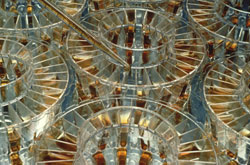
Oxidation of alcohols and carbohydrates with molecular oxygen, catalysed with noble metals, is a clean process that can be applied profitably in fine chemistry industry for the synthesis of pharmaceutical products. It holds the promise of an interesting alternative to avoid highly environmentally toxic oxidation processes that use conventional inorganic oxidants. The potential benefits of selective oxidation of organic feedstock in a catalytic micro-structured reactor, offering precise control of oxygen concentration along the reaction pathway, have been demonstrated in the CREATION project. Researchers at the University of Bath designed, built and tested a millimetre-scaled compact reactor, consisting of parallel reaction channels packed with catalyst particles. The system's geometry was optimised to provide enhanced control on the fluids flow pattern, while intensifying their contact in a three-phase (gas-liquid-solid) reaction environment and speeding up mass transfer processes. In addition, a heat exchange system was integrated within the structured assembly to provide for highly exothermic reactions and to allow control over temperature differences and isothermal operation despite high reaction rates. The multi-functional reactor's suitability for clean oxidation of benzyl alcohol to benzaldehyde, which was used as a model reaction, was illustrated in laboratory experiments performed on ruthenium and platinum-based catalysts. High selectivity was observed over a broad range of operating conditions, even when working with reactant concentrations approaching industrial conditions. In the next phase of research, a bimetallic catalyst system will be developed to achieve the performance required in fine chemical and pharmaceutical synthesis.