Cooperative, self-organised robots

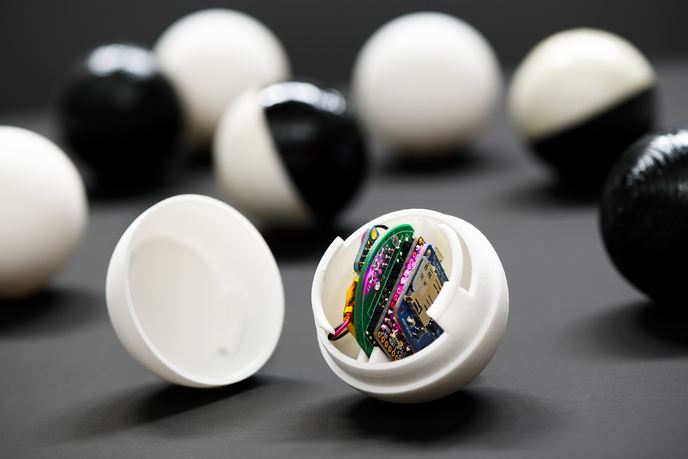
Self-assembly of discrete and autonomous entities has led to the design of collectively acting modular robots. However, the capabilities of such systems are vastly unexplored mainly because of shortcomings in current hardware implementations. The EU-funded project 'Autonomous evolution of robotic organisms' (EVOLVINGROBOT) addressed how complex patterns or structures can arise in systems of numerous interacting robotic units. Researchers' designed a novel self-assembled system that is composed of macroscopic building blocks that float in an agitated medium. Its dynamics allow the blocks to physically bind with each other and disband. When comprising a large number of blocks, such systems could be used to study the emergence, reproduction and evolution of life-like organisms. The breakthrough, allowing robots to act collectively in a way never achieved before, could herald a paradigm change in robotics. Rather than building robots of ever increasing complexity, the project suggested that extremely simple mechanisms can enable a range of potential capabilities. The process was governed solely by the building blocks and their local interactions in the absence of any blueprint or central command. This made it possible to drive the system towards an organism population that is adapted to its environment. EVOLVING ROBOT succeeded in getting miniature robots, acting autonomously on the basis of very simple pre-programming, to perform a number of collective tasks. These tasks included gathering together in a single place, segregating themselves into distinct sub-groups, cooperatively transporting objects, and cleaning up an area. Scientists found that none of them required the robots to communicate with each other. In addition, some tasks did not require them to have memory or be able to compute at all. Furthermore, the project developed a series of prototype units that were able to harvest energy from the environment, and be able to control when and where to move. In addition, a self-folding, modular robot that is able to transform between two- and three-dimensional configurations was developed. Project outcomes could pave the way for implementing massively distributed robotic systems at unprecedented scales that conventional sensing and information processing approaches cannot achieve.