


CORDIS at the European Robotics Forum 2019: Robots promise to power European industry

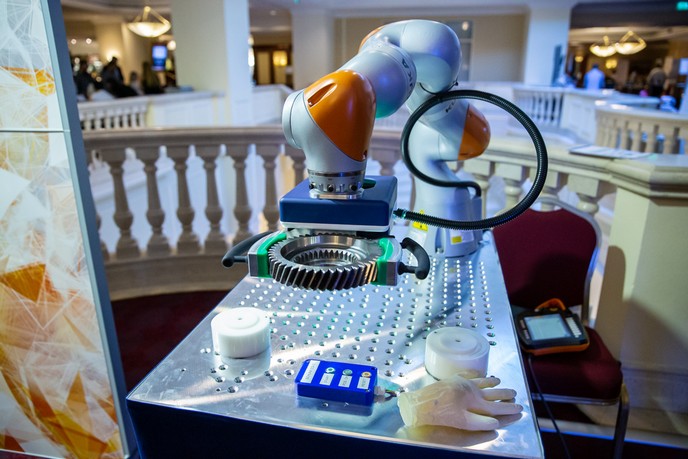
In our second article detailing some of the fabulous robots we met at the European Robotics Forum we looked at robots that are revolutionising the healthcare industry. Now we turn to arguably the next major sector which will feel the full effects of the ongoing robot revolution – industry. Automation of industry is not a new occurrence – it has been a rolling trend since at least the 1990s but now, as we reach towards the third decade of the twenty-first century, it appears that robots could dominate the next wave of industrial automation. Obviously, this causes much fear that such an outcome could result in large-scale manufacturing job losses, but, as was said by Lucilla Sioli, Director of ‘Artificial Intelligence and Digital Industry’ at the Commission’s DG CONNECT during the forum’s opening ceremony, there is no tangible evidence that an increase in the use of robots would negatively impact employment rates. This was reinforced by several of the forum delegates that we engaged with – the idea being that in industry, robots won’t replace humans, but rather the two would work more effectively together to improve existing industrial processes but also to allow innovative new processes to flourish, which would benefit all of society. Arguably one of the ‘stars’ of the exhibition was PAL Robotics’(opens in new window) REEM-C robot which was even smartly dressed in traditional Romanian garb for the event. Originally founded in Barcelona in 2004, PAL Robotics specialises in service robots (such as its stockbot(opens in new window) which helps to count and keep track of warehouse stock) and humanoid robots, including REEM-C(opens in new window) and its more advanced brother, TALOS(opens in new window). REEM-C is currently being used in two EU-funded projects: socSMCs(opens in new window) and EUROBENCH(opens in new window) whilst TALOS is taking part in the MEMMO(opens in new window) project. TALOS is able to lift six kilos and is currently being tested in an Airbus factory where the aim is to give the robot a ‘database of memories’ that will allow it to react in a real-time situation in an industrial setting that ensures that both it and humans that it is working with remain safe and able to work together effectively. What marks both robots out is their ability to ‘feel’ through advanced sensors at various points on their bodies – REEM-C is arguably the trailblazer, which is equipped with fewer sensors than TALOS being used in EUROBENCH as a means to benchmark humanoid robots so they can ‘enter the real world’ in a safe and intelligent way, including in industrial settings. Robotic sensitivity was also emphasized by Kuka Robotics(opens in new window) that specifically specialises in industrial robots and took part in the EU-funded COLROBOT(opens in new window) project that ended only in January and was featured in our special feature on robotics in the latest issue of Research*eu magazine. This project spent three years designing and implementing an integrated collaborative robotic system. Their technology consists of a mobile manipulator which acts as a ‘third hand’ for production line workers: It can autonomously move around the factory looking for pieces or tools, deliver them or hold them while the operator performs another task. Indeed, at the exhibition itself, PAL Robotics, Kuka and many other innovative robotics companies, have definitely highlighted how the next industrial revolution is really going to be propelled forward by sensitive, autonomous robots that are able to easily and safely work together with the human workers around them.
Countries
Romania