


Features of cooling and heating of the nest by the bees, and control of processes related with it. Part 2 - Cooling. Hypothesis.
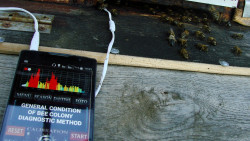
Consider the process of cooling of a nest by the bees. It has three different types according to efficiency, which, successfully complement each other : 1. Vaporization cooling - Cooling of the nest with the use of evaporation of "sweat" released by the bodies of the bees, with the help of air flow, blowing around their bodies, which bees make by flapping their wings. This process is very close to the soundless heating process because it uses the processes in living biological body. The energy for these processes is obtained by the bee as a result of metabolism. This is important because it is built on chemical processes having a finite speed. Bee can't "sweat" with any speed which she would like to have. Therefore, no matter how effectively will be increasing of the air flow speed for the liquid evaporation. The rate of air flow can not grow indefinitely. As we said, there is an optimum mode. And the maximum value at the same time, we believe, comes when the flapping wings of a bee create a sound at a frequency of about 100 Hz. So, the range of sounds that characterize vaporization cooling, lies between 20 and 100 Hz. Our device can capture this process only when intensity of this process increases, and frequencies of the sounds shifts to the range of 70(50)-100 Hz. 2. Vaporization cooling using water, brought to the hive by the bees - This cooling method has the same principles as the first, but use an unlimited amount of water which can be vaporized. It can be steamed for a long time, it is possible to vaporize it in large quantities during short time. Important is only opportunity to bring water to the hive. For this purpose very often bees during honey flow switches to delivery of water to the hive, instead of delivery of nectar. The quantity of bees delivering water to the hive have direct dependence from the quantity of the brood in the nest of the family. The more brood in the nest - the more the bees, delivering water. Now, let's find out, what are the characteristics of this method of cooling the nest for us, in accordance with principles of acoustic control. The main fact - is that the bees while using this method can make air flow of unlimited force. The greater the amount of air blow to water droplets, the faster it will be evaporated, and the better it will cool the surface on which it was placed. And here, the bees are limited only by their physical capabilities. They can reach maximum speed of air flow. We believe that the minimum velocity of air flow during such type of cooling, is higher than during the cooling process of the first type, when bees are making air flow around their bodies. We believe that at these speeds, the bees create sounds in the range of 100-180Гц. But, this kind of cooling is possible only in the presence of large water supplies near the hive. In the hot time of year, in a arid place, this principle does not work. In addition, the same effect ( cooling) is a by-product of moisture removal from honey during the honey flow. The greater the honey flow, the faster the bees want to remove the moisture, and the more rapid the air flow they create. It is assumed that bees use the maximum speed. 3. Ventilation of the nests and the hive without evaporation of water. You can, in fact, call it aeration of the nest in order to maintain the desired conditions on carbon dioxide concentration and humidity. The main objective of such type of ventilation - is to deliver fresh air and cool the nest, if the air outside the hive is colder than air inside. The air velocity here is not limited, and the bees regulate it on their own. During such ventilation, the bees create sounds with a frequency from 100 to 180 Hz. But we assumes, that the bees mainly use the middle speed, creating sounds in the frequency range 100-140 Hz. Thus, the system of "conditioning" of the hive uses three modes and all their combinations, respectively prevailing to conditions.
Paesi
Germany, Spain, France, United Kingdom, United States