Space storms tracked from Sun to Earth

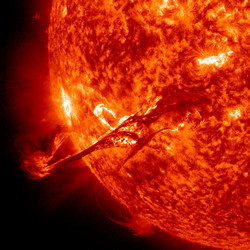
CMEs are massive clouds of plasma and charged particles that are unleashed into space during ferocious solar storms. When CMEs are aimed directly at Earth, they cause disturbances in the Earth's magnetic field. These solar eruptions could disrupt power grids and telecommunications networks on the ground and also knock out satellites in space. The 'The relationship between white light and in situ observations of coronal mass ejections' (WILISCME)(opens in new window) project, analysed new observations from STEREO. The twin STEREO probes are able to image Earth-directed CMEs in white light at two different points far away from Earth. The same eruptions are sampled by additional spacecraft closer to Earth in situ. Observations of 22 CMEs(opens in new window) led to the discovery that the way CMEs propagate from the Sun to Earth is not so varied. There are three distinct phases: impulsive acceleration followed by rapid deceleration and finally speed stabilisation. WILISCME researchers were also able to deduce the 3D shape of interacting CMEs. In the past, thousands of CMEs have been observed by satellites. How their shape changes when they interact remained unknown as these observations were made from a single point. With the STEREO, CMEs can be tracked over a wider area than any other spacecraft — from the Sun to the orbit of Earth. The STEREO probes also enable the imaging of CMEs from various angles, improving the ability to assess the direction and speed of CMEs. This advantage was exploited by the WILSCME scientists to predict the time of arrival, speed and orientation of the CMEs. In particular, the uncertainty in accurately predicting the time that a CME will hit Earth was reduced to only 6 hours. WILSCME has improved the accuracy of space weather forecasts using solar observations, necessary for the development of services for society, such as solar activity reporting. The output was shared with the scientific community in 20 papers published in peer-reviewed journals and 50 oral and poster presentations at international conferences.