


We must be ambitious, Busquin tells Berlin audience
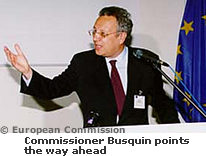
Speaking at the Friedrich-Ebert-Stiftung in Berlin on 18 January, European Research Commissioner Philippe Busquin outlined why European research has to change and the way forward. Mr Busquin spoke about the creation of the European Research Area (ERA) as essential in order to deal with budgetary difficulties, the lack of human resources, globalisation, EU enlargement, forging closer cooperation at all levels and the opening up of research projects. 'We cannot continue to work and to reason with the tools and approaches of the past,' said the Commissioner. Mr Busquin talked of the 'European paradox', the fact that European technological performance is inferior to that of the United States, despite a freeze in its decline. 'But a second paradox has developed,' said Mr Busquin, 'although European high technology exports are on the increase, returns in investment are relatively modest.' The Commissioner called upon Member States to face up to their responsibility of providing adequate funding for research, reminding his audience that average EU investment in research remains at 1.8 per cent, compared with 2.7 per cent in the United States and 3.1 per cent in Japan. Mr Busquin warned that the human resources shortage will increase, and stated that the creation of an ERA is a way of dealing with this: 'In a context of budgetary difficulties, where human resources will probably constantly decline, with the constraints of globalisation and the objectives of enlargement, it is vital and urgent that we share our resources and coordinate our efforts more effectively.' The aspect of science and society also received much attention from Mr Busquin in Berlin. He expressed his alarm at the findings of a recent survey in France which indicated that only 63 per cent of those questioned, and 74 per cent of those between 18 and 24 years old regarded themselves as inadequately informed about scientific discoveries. The ERA will provide a basis for further exchange between citizens and scientists, Mr Busquin said, as well as increasing cooperation between all actors involved in research: scientists, political decision-makers, research administrators, industrialists, consumers and those who use of results provided by research. Looking to the future, Mr Busquin maintained that the European Commission's Sixth Framework Programme, which will be simplified and more flexible than the present Fifth Framework Programme, will no longer be the sole objective of European research priorities, but will come to be regarded as an element of the ERA. The Commissioner conceded that there are some challenges ahead, but remained positive about the future: 'The objective is obviously ambitious, but should we not be ambitious?'including resear