


Research Ministers welcome FP6 proposal
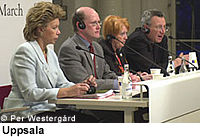
Meeting in Uppsala, Sweden, EU research and education ministers welcomed the Commission's proposals for a new framework programme on research, and highlighted areas where efforts should be strengthened. The Commission's proposal for the Sixth Framework programme (FP6) was outlined by Research Commissioner Philippe Busquin on 21 February 2001. The proposal includes a 17 per cent increase in allotted resources, which will be spent, among other things, on increasing researcher mobility and fostering closer cooperation between the EU's leading research environments. Seven areas of research will also be awarded priority: biotechnology, information society technologies, nanotechnologies, aeronautics and space, food safety, sustainable development and the relationship between citizens and governance. 'Ministers welcomed the strategic vision and clear message of support for research and innovation,' said current chair of the Research Council Thomas Östros, as he closed the meeting. 'They endorsed the key principle of focusing on a limited number of priorities to achieve critical mass and European added value.' The Minister went on to add however that concerns had been expressed about the marginalisation of smaller research actors in the light of concentration. Amongst the priority themes, Ministers stressed the importance of a concerted effort for the development of biotechnology in Europe, with full regard to research, industrial innovation, entrepreneurship and quality of life, as well as the importance of an open public discussion on ethical issues. Ministers highlighted the need to get greater involvement of SMEs (small and medium sized enterprises), and to tackle the shortage of human resources for research. They also welcomed the Commission's proposals for increased support for measures to promote SME participation. Ministers stressed the importance of following up the initiatives launched by the European Council in Lisbon regarding fundamental IT proficiency, and stated that countries should make full use of the existing programmes and funds at both national and European level. Ministers also welcomed proposals to improve the training and mobility of researchers. The Commission has proposed new instruments be employed by the Commission for the implementation of FP6. 'Given the importance and complexity of the matter, it was considered essential that the question of instruments be examined in depth. This should be done as a matter of urgency within the appropriate Council bodies to which the relevant high level national experts should be invited to attend,' Minister Östros said. 'Ministers welcomed Commissioner Busquin's intention to hold an open seminar with representatives of the research community to exchange ideas on how the detailed implementation rules should be defined.' Those attending the meeting agreed that the subject should be approached from a broader perspective, considering the needs of both research and education. 'Ministers considered that a more thorough analysis, common to education and research, needs to be undertaken, taking into account all different possibilities of encouraging the interest of young generations for higher education and research in general, for teacher education and for science and technology in particular. It was stressed that measures to stimulate recruitment must comprise a general renewal of pedagogy and good links to working life and industry through the whole educational system,' concluded Mr Östros. Schools must also play a role in the discussion of ethics, which has seen a raise in profile with the rapid developments in biotechnology and genomics. 'The ways that schools can handle these questions will influence the attitudes of the young, and the confidence that society at large has in scientific and technological development will affect the interest of new generations in developing careers in science and technology,' said Mr Östros, who added that representatives from science and industry must also engage in a dialogue with the public about these issues. Discussions will continue in the CREST committee (Comité de la Recherche Scientifique et Technique) and in the Research Ministers' Council meeting in June, with the aim of preparing a concrete action.
Countries
Sweden