


Innovation in Europe - Liikanen talks to CORDIS News
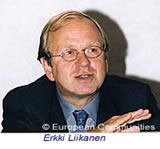
On the advent of European Union revealing the contents of its first innovation scoreboard, the European Commissioner for Enterprise and Information society, Erkki Liikanen, spoke to CORDIS News to clarify what it means to Europeans, how it helps, what its effect on policy will be and the background to its creation. CORDIS News: How does the Innovation Scoreboard support the innovation process in the EU and help Europe to be more competitive? COMMISSIONER: There are several ways it achieves this. I think the first and most important way is to stimulate reflection and raise awareness among a wide cross-section of citizens. Secondly, the Scoreboard focuses attention on the factors that contribute to innovation. These are not universally well defined, and even when they are, they are sometimes not fully understood. Finally, I would point out that the scoreboard's set of innovation indicators provides a tool that policy-makers and opinion-formers can use to drive home the messages about innovation within their Member State or within their specialist area, and to plan more effectively to create an innovation culture. Innovation, leading to new products and production processes, is an important determinant of productivity improvements and economic growth. Promoting entrepreneurship and innovation in Europe are therefore vital to boost our competitiveness. CORDIS News: Explain the background to the Innovation Scoreboard initiative: what is it intended to achieve? COMMISSIONER: The Commission believes that benchmarking is an important tool; not only for comparison between one Member State and another, but for comparing approaches and processes to see what works and what does not. The Commission has undertaken benchmarking initiatives for several years. More recently the Innovation Trend Chart had been contributing to this. The scoreboard was conceived as part of the Trend Chart. The Trend Chart provides policy-makers and managers of support schemes with comprehensive information and statistics on policies, performance and trends in the EU, and has become the basis for benchmarking and the exchange of 'good practices'. One important output of this benchmarking exercise is the Innovation Scoreboard, with detailed indicators for innovation and its progress in Europe and beyond, comparing the capacities of Member States to foster innovation. This issue came to the very top of the political agenda at the Lisbon summit in 2000 at which the Council formally requested that the Commission produce and publish the Innovation Scoreboard. It is seen as a way to draw attention to the importance of innovation at political level and to allow the Member States to see their own position compared to other Member States and to the European Union in general. CORDIS News: Why is there a need for a specific Innovation scoreboard alongside the R&D and Enterprise scoreboards? COMMISSIONER: Innovation is one cornerstone in the triangle of interdependencies between industry, research and innovation. The amount of research results the EU generates is important to the competitiveness of its industries. But if we fail to understand and nurture the link between research and industrial competitiveness then we do not get the best out of researchers or entrepreneurs. In many ways, innovation is the more abstract and the more difficult of these three factors to understand: it can also be seen as the vital link which binds the other two. Thus I feel it is necessary both to highlight innovation itself and to establish more clearly that research alone does not automatically guarantee that innovation will happen within enterprises. CORDIS News: What does the Innovation Scoreboard indicate about the business climate in Europe and what evidence does it provide about Europe's ability to withstand the economic downturn? COMMISSIONER: The scoreboard is a long-term benchmarking exercise, which will help enormously to measure and compare our competitive performance throughout different economic cycles. What is needed is sustained long-term improvements in innovative ability. The mobile phone market, in which Europe is well ahead of the US, is to me a good illustration of how innovation in the sense of the effective application of research can not only give an edge in global competition, but also can generate new markets which no-one would have imagined a few years ago. In terms of business climate, it is very interesting to note the correlation revealed in the scoreboard between Member State performance in the overall rankings and the differences in business cultures throughout the EU. It would seem to suggest that business cultures that encourage risk and have flat management structures are ones in which innovation flourishes. CORDIS News: Do you think that the differences in national performances highlighted in the Innovation Scoreboard can impede business policy in Europe? COMMISSIONER: In terms of global competitiveness, poor innovation performance certainly could be a handicap. In the European Union, the conditions and the need for innovation policy learning are exceptional: while some of the world's innovation leaders are Member States , differences in national innovation performances remain significant. This demonstrates the enormous potential for the exchange of good practice and learning within the Union. However, we have to realize that, although there are substantive national differences in innovation performance, there is no single 'best way' of innovation policy in Europe. To compare innovation performances, and even more, to assess the transferability of "good practices", it is essential to understand the specific national environments behind these performances and policy practices. The challenge for Member States is not to copy the best performers, but to define their own original innovation policy, taking into account specific strengths, weaknesses, priorities and cultural and institutional traditions. This supposes a broad political debate among stakeholders. The Commission intends to play a crucial role as a catalyst in this political debate to enhance co-operation between the Member States and the Union. CORDIS News: What practical measures are you planning to address weaknesses identified by the Innovation Scoreboard? COMMISSIONER: The Commission has developed the Trend Chart initiative to provide detailed information on individual schemes and methodologies that should help the spread of good practice, thus helping to improve innovation performance. The scoreboard delivers precise comparisons in a set of innovation indicators. However, it is up to the Member States to make use of the information to benchmark their own policies, schemes and innovation capacities. Improving innovation is something that both governments and entrepreneurs have to take on board - we can provide the information they need to make their case and to enable them to see the effects of innovation policy measures. CORDIS News: What can the Innovation Scoreboard mean for the Accession Countries and how can they benefit? COMMISSIONER: I believe that they will find the scoreboard gives them a very useful tool in order to assist in preparing for accession. The transparency of the method of construction of the scoreboard allows them to make their own national benchmarking exercises. Also, using the Trend Chart in conjunction with the Scoreboard, they can reflect on policy measures taken within the different Member State cultures and see how successful they have been. The aim is to gradually involve the Accession Countries and to include these countries in the 2002 Innovation Scoreboard, subject to the availability of statistical data. This openness and sharing of information is fundamental to realising the European ideal. Innovation is not a subject in isolation; it links to areas like education, research, taxation, law, and enterprise, all of which come under the spotlight in the accession process. CORDIS News: Innovation has its strongest roots at regional level. How can the regions benefit from this scoreboard exercise? COMMISSIONER: We share this opinion, that the regional dimension of innovation is very important. I know that some regions have already started their own benchmarking and scoreboard exercises using the structure and information from the Innovation Scoreboard. Much of the information in the Trend Chart database is regional in nature and serves as a knowledge base from which a lot of useful information can be drawn. The important thing is that the regions take the time to look at the information and investigate the possibilities before making policy decisions. CORDIS News: What does the Innovation Scoreboard indicate about the role of women in the innovation process in Europe? What measures are likely to result from that? COMMISSIONER: It would be possible, and interesting, to see research into the correlation between Member States who are most successful at utilising their full range of citizens and their innovative capacity as shown by the scoreboard. I suspect that gender barriers would be seen to have a negative effect in which case it would make the case for policy measures to reduce gender discrimination in the interests of improving innovation and economic growth. Of course this issue is already being highlighted in the field of scientific research where it is well known that women are under-represented.