


Innovation Scoreboard shows EU innovation is better - but not the best
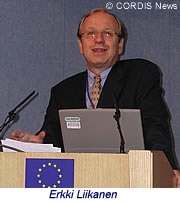
The European Commission's 2001 European Innovation Scoreboard, made public on 1 October, shows that while all Member States are improving, with some achieving world class performance, the EU as a whole still lags behind the USA and Japan in the field of innovation. Weak investment in research and development (R&D) by European business and a low-level of high-tech patenting activity were of particular concern. Presenting the scoreboard, Enterprise Commissioner Erkki Liikanen said: 'The scoreboard provides a tool for policymakers and opinion-formers to drive home the message about innovation in their Member State and to plan more effectively to create an innovation culture.' The scoreboard uses 17 indicators to rate each Member State's capacity for encouraging innovative business and improving the competitiveness of industry through innovation. The indicators are grouped into four areas, covering human resources and the skills base, the creation of new ideas (based on R&D expenditure and patent applications), innovation in business, and innovation's financial outputs and markets. It shows that the overall innovation performance of the EU is improving, with traditionally strong countries such as Finland and Denmark surging ahead. Greece and Spain, traditionally weaker in innovation, are also catching up, though from a relatively low level. The three largest EU economies, France, Germany and the UK, are improving, but at rates below the EU average. Overall, however, the gap between the best and weakest-performing states appears to be widening. 'Rapid increases in business R&D in Japan and the USA since 1994 have increased the gap with Europe,' the study says, while showing that US business R&D spending is 74 per cent higher than the EU average. Longer term figures for 10 of the indicators also show that despite an average improvement of 30 per cent over the past four to six years in these areas, public R&D spending, business R&D expenditure and value added from high-tech manufacturing have all declined. In addition to figures for individual indicators in each Member State, the scoreboard also combines all of the indicators to arrive at a single figure for each country - the 'summary innovation index' (SII). This ranges from +10 to -10 to reflect the proportion of indicators which are above or below average. Sweden leads the field with an average SII of +6.5. Comparable figures are available for the USA and Japan for 10 of the indicators. These show that the most that the most significant US advantages over the EU include the level of R&D activity by businesses, the amount of new capital raised and the percentage of the working population with post-secondary education. The EU leads only in the supply of new science and engineering graduates. Compared to Japan, the EU leads in the level of public spending on R&D and spending on information and communications technology and services. However, the rate of R&D activity by Japanese businesses is almost double that of the EU. Japan also produces more science and engineering graduates and a higher percentage of the working population with some form of post-secondary education. Commenting on the scoreboard results, Mr Liikanen called on Member States to take 'a more co-ordinated and coherent approach' to innovation. He particularly highlighted an 'urgent need for action in the field of education and training' to boost EU innovation performance. Commissioner Liikanen said that the next innovation scoreboard, which will in future be updated and published annually, would include figures from EU candidate countries to help prepare for EU enlargement. He also spoke of ambitions to include a greater regional dimension on the 2002 scoreboard, including a series of complementary regional indicators, depending on data availability and contributions from the regions. The European Innovation Scoreboard was requested by the Lisbon European Council of March 2000 as part of its strategy for turning the EU into the most competitive knowledge-based economy in the world. It is part of a wider EU benchmarking initiative to identify areas of weakness and of strength in efforts to achieve this target. Commissioner Liikanen also emphasised that the EU must continue to press ahead with its innovation agenda despite the new priorities brought about by the US terrorist attacks of 11 September. 'We must keep European competitiveness high on the agenda or our capacity to create jobs and wealth will diminish,' he said.