


Space ministers meet to decide on future space programmes and budget
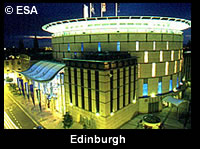
The ministers responsible for space activities in the 15 European space agency (ESA) Member States and Canada are gathering in Edinburgh, Scotland on 14 and 15 November to endorse the next stages of ongoing projects, including Galileo, and commit to new programmes. The aim of the ESA council meeting is to implement policies which will strengthen the public sector's involvement in space activities by giving it direction. The council is also intended to be instrumental in confirming the mandate given to ESA to develop further towards becoming the space agency for the European Union. The programmes tabled for discussion at the meetings cover the development and validation phase of the Galileo satellite navigation system, Earth observation, telecommunications technology, the international space station (ISS), launchers and the Aurora exploration programme. The funding available for the period 2002 to 2006 will also be decided at the meeting. The level of resources was reduced during the 1990s and emphasis placed on increasing management efficiency. It is now felt however an increase of around four per cent over five years is necessary in order to ensure a balance between basic activities and optional programmes. The Galileo project, a joint initiative between the European Commission and ESA comes under ESA's optional telecommunications programme. The design, development and validation phase is due to run from 2001 to 2005. ESA's contribution to this phase is 550 million euro, 53 million of which has already been subscribed, leaving a request to the ministers for 497 million euro. For the general budget, which covers corporate and administrative costs, technical activities such as the general studies and technological research programmes, ESA is seeking a commitment of 919 million euro (at 2001 economic conditions) from the ministers for the period 2002 to 2006. The 'backbone' of ESA's programmes is the Science programme. ESA is requesting a budget increase over the coming years in order to ensure that 'Science can remain a European flag carrier in a competitive global environment, contribute to Europe's knowledge based society and perform its strategic role as a source of information,' according to ESA. Funding for the next five years is intended to cover maintenance of plans for scientific missions already launched, approved scientific missions in the development phase, new missions under study or to be chosen and initiated in this period and new missions approved but not possible without increased funding. The expected commitment from the ministers is expected to amount to 1945.1 million euro at 2001 economic conditions. This is lower than had been hoped, and ESA believes this is likely to prevent the proposed Mars express bus re-use mission in 2005 and could result in delays to mission such as GAIA and Solar orbiter.