


De Donnea promotes scientific careers with Ishango prize
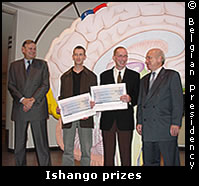
François-Xavier de Donnea, President of the EU Research Council and Minister President of the Brussels-Capital region, outlined the importance of encouraging young people to pursue careers in science at the presentation of the first Ishango prize for young scientists in Brussels on 14 November. The prize, created at Mr de Donnea's initiative, is part of the Operation Ishango campaign launched by the Brussels-Capital region to increase awareness of science and encourage young people to take up scientific careers. The competition awards two prizes of 2,500 euro to young researchers or science students working in the region, one francophone and one Flemish. Speaking at the award ceremony, Mr de Donnea said that 'scientific research and the developments it leads to are two key components of economic growth,' adding that 'the contribution of young people is vital in this context' as it breathes new life and motivation into the process. He said it is vital to encourage young people to take up careers in science as 'intellectual resources are Europe's key asset.' The 2001 prizewinners were chosen from a total of 25 candidates. Dr Thomas Hamelryck won the Flemish Ishango prize for his work on 'The identification of potential functional sites in protein structures' at the institute of molecular biology of Vrije Universiteit Brussel (VUB). Dr Hamelryck said that while communication between scientists and the public is important he doesn't see it as scientists' role. 'I do think it's important to have an interface with the public, although scientists are often not the best people to do this,' he said. Dr Hamelryck does not feel that the public have a negative view of science, saying he believes that scientists' work is valued by society. 'I hardly ever encounter negative reactions,' he said. Dr Hamelryck, who spent a year doing research work in Denmark after graduating from VUB in Belgium, added that he thinks that researcher mobility is an important aspect of a scientific career and should be encouraged. He explained, however, that he thinks researcher mobility is more difficult within Europe than in the USA because of the bureaucratic procedures involved and language barriers. The francophone prize was won by Dr Alain le Moine for his work on 'The role of eosinophiles in allografd rejections' at the Laboratoire d'immunologie expérimentale of the Université Libre de Bruxelles (ULB). Dr le Moine said he was very happy have been awarded the first Ishango prize which he described as 'symbolic.' He said that the mixture of scientific disciplines in both the candidate projects and the members of the jury was a key aspect of the Ishango prize, as it meant the candidates' work had to be presented in a way comprehensible to those who are not experts. He added that the accessibility of scientific work to the public must be a 'first priority' to ensure that the huge financial and other investment in scientific research is appreciated and exploited to the full.