


New drugs for HIV and new asymmetric catalysts share 1 million euro Descartes prize
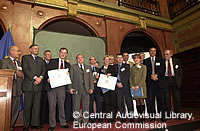
Unable to decide between two very different examples of scientific excellence, the jury for the EU Descartes prize for outstanding research through transnational collaboration this year awarded the prize to two projects, 'Development of novel drugs against human immunodeficiency virus (HIV)' and 'Development of new asymmetric catalysts for chemical manufacturing'. The two project teams, represented at the award ceremony in Brussels on 27 November by Professor Jan Balzarini of the Rega institute for medical research in Leuven, Belgium (novel drugs) and Dr Michael North from King's College, London (asymmetric catalysts) will share the one million euro prize money. The awards were presented by EU Research Commissioner Philippe Busquin in the presence of current Research Council Chairman François-Xavier de Donnea and Director General of the Research DG, Achilleas Mitsos. The Descartes prize is part of the Fifth Framework programme's (FP5) Improving human potential programme. Prize winner Dr North was the coordinator of a project to develop new asymmetric catalysts for chemical manufacturing. The project involved scientists from the UK, France, Germany, Russia and Armenia. Dr North had not expected to win the prize, he told CORDIS News. 'I think you have to be surprised when you look at the quality of some of the other research being done, particularly medical research, which is going to have a fairly short term impact on European citizens. To be ranked up there with them is really a surprise and a very pleasant one,' he said. Two reasons probably underpinned the award, according to Dr North. 'I think we managed to do two things, which are very good in the European context. One is that we managed to combine fundamental research and take it all the way through to the stage where it's now being applied industrially, so in addition to being academically stimulating, we managed to do work which is going to contribute to the profitability of the European chemical industry. Also, we had a collaboration which involved not only groups from various countries within Europe, but also bringing Russia and Armenia in,' he told CORDIS News. Work on Dr North's project first began in 1992 when the consortium received an INTAS grant, a programme funding the promotion of cooperation with scientists from the independent states of the former Soviet Union. This was then replaced with funding from the INCO-COPERNICUS programme a year later, this project being one of the first to receive funding from the programme. 'I think we've probably highlighted what the European Union regards as its potential strengths: the ability to do research in an interdisciplinary area involving groups from really all over East and West Europe,' said Dr North. Director of the jury responsible for choosing the prize winners from seven finalists, Yves Michot, former President of Aerospatiale Matra, explained that the project on new drugs for HIV sufferers will receive 700,000 euro, and the asymmetric catalysts project, 300,000 euro. 'This does not mean one project is better than the other,' explained Mr Michot, saying it reflected the jury's perception of where the money is most needed. Dr North explained to CORDIS News that his team will use the money to continue working together. 'We'll use it to continue the collaboration because the INCO-COPERNICUS grant is now finished, but hopefully this will allow us to carry on working, all the groups in Western Europe and Eastern Europe, together, and hopefully we will be able to discover new catalysts for different reactions and maybe we'll be back here in three or four years time shortlisted for another Descartes prize!' The other winning project brought together researchers from six countries and involved the discovery of new medications as well as identification of new sites in the HIV replication cycle which are particularly suitable for the targeting of pharmaceutical intervention. New inhibitors were discovered, and one of the new compounds has recently received unanimous support from the US Food and drug administration's antiviral drug advisory committee. It is expected that it will be officially approved for widespread use before the end of the year. Project participant Christopher McGuigan said that the new compounds are already being used for HIV patients. Research DG Director General Dr Mitsos said at the ceremony that the aim behind the Descartes prize was to push European research by stimulating the furtherance of research. Research Council chair Mr De Donnea lauded collaborative projects such those presented at the ceremony, saying 'Europe is lagging behind the USA partly because of divisions.' He added that 'more flexibility must be given to researchers to give them a clear field.'