


Building bridges between science and society
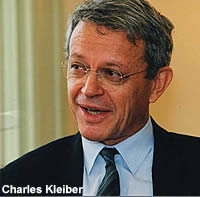
What the Commission can, and cannot, do to intensify the dialogue between science and society were discussed at the Belgian Presidency event on 'Public awareness of science and technology in Europe and its regions' in Brussels on 17 December. Improving the relationship between science and society 'cannot be an isolated field of the European Commission. This is a field where we must all act together,' said Rainer Gerold, Director of the Research DG's science and society directorate, who called for the full participation of the Member States. What science really needs is 'public understanding in the modern sense - dialogue,' said Mr Gerold. He added that scientific advice depends on interaction with the public as, in a democracy, policy must be understood. Charles Kleiber, Secretary of State for research in Switzerland took this position, saying that 'you have to go to the citizens, on the street, in hospitals, everywhere, you have to ask questions.' The dialogue should deal with daily matters or fears, said Mr Kleiber. When people perceive something as being relevant to them, they want to learn, as demonstrated when a lot of Europe was experiencing floods and climatic changes. Mr Kleiber stressed that science has to remain relevant. 'If there's not enough faith, there's distrust,' he said. He added that citizens will ask questions, and that all sorts of 'dangerous dialogues' are possible, but that these should not be avoided. Anne-Marie Straus, Director General of the general directive for technologies, research and energy in the Walloon region of Belgium echoed this point, saying that 'the role of science is not only to say what is good, but what is true.' On funding, Mr Gerold said that it is irrelevant that 'science and society' only received 0.3 per cent of the budget for the Sixth Framework programme (FP6), because what is important is to integrate this issue into the other priorities. 'If we keep it separate, we will not get anywhere,' he said. Mr Gerold hailed the success of initiatives such as 'science week' for raising the public profile of science, but emphasised that here too, Commission funding should not be central to its success, adding that the commission does have budgetary limits. Mr Gerold said that he would like to see more national and regional initiatives. Spain has already responded to this call, and next year will organise nationally funded activities in Madrid to coincide with European science week. Mr Gerold said that he would also like to see more of a European element in national science weeks and science days. 'There is no need always to include a European element, but we have a lot to learn from each other,' he said. For science weeks to achieve their objective - increasing the public's awareness of science - a balance between entertainment and understanding must be struck, said Mr Gerold, who said that while he is 'not advocating dull science days', he sometimes has the impression that entertainment is taking over. Michel Oleo, advisor to Minister Dirk Van Mechelen, the Minister for finance, budget, innovation, media and town and country planning in Belgium's Flanders region said that in Flanders they too know the limits to public funding, and are currently concentrating on how to focus their campaigns so as to have the maximum impact with limited resources. The ministry is also looking at how to measure whether they are reaching more people, although they are not yet sure how this will be done. Calls for a more bottom up approach were greeted enthusiastically by Mr Gerold, who gave particular praise to science shops, and said that the Commission would like to sponsor such an initiative in such a way as to enable science shops to exchange best practices. A call for the introduction of bilingual scientific communication, in both the local language and English on the basis that language barriers present a barrier to the European research area (ERA) was rejected by Mr Gerold. He pointed out that the Commission does finance the production of other language versions of successful science television programmes, but said that while English may have become the lingua franca of the scientific community, it has not yet become the lingua franca of the European Community.
Countries
Belgium