


Thinning in ozone layer increased Europe's exposure to UV rays
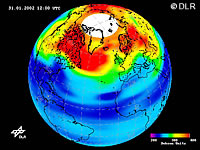
The European space agency (ESA) has announced that the protective ozone layer over Europe grew thinner between 28 and 30 January, leading to an increase in exposure to ultraviolet (UV) radiation. Scientists monitoring the ozone layer using a rapid mapping technique based on data from the global ozone monitoring experiment (GOME) instrument aboard ESA's ERS-2 satellite detected 'finger-like ozone thinning' over Europe, according to ESA. The thinning of the ozone layer observed during this period increased exposure to harmful ultraviolet rays from the sun by between 20 and 30 per cent under clear skies. 'From 28 to 30 January we observed a pronounced 'streamer event,'' explained Thilo Erbertseder from the German aerospace centre (DLR), 'where streamers of tropical air pushing up from the equatorial regions spread over southern Spain, France and Germany. Ozone levels in tropical air are much lower than those over more northern regions, and the end result was to decrease total ozone coverage to a low level of only 250 Dobson units.' The occurrence of mini ozone holes is more frequent over Europe than anywhere else, said Mr Erbertseder, and this frequency is increasing, leading to a rise in exposure to harmful biologically active UV radiation.