


Seven newcomers join 'club of excellence' at award for innovative regions
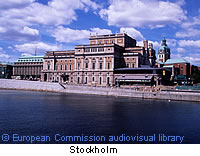
Seven new European regions were recognised at the 2002 Award of Excellence for Innovative Regions, held during the Third European forum for innovative enterprises in Stockholm, Sweden, on 8 April. At the ceremony Berlin, Copenhagen, Dublin, Edinburgh, Hamburg, Veneto and Vienna joined the club of excellence. A total of 22 regions were recognised at the award, the remaining 15 of which were also nominated at the Second European forum for innovative enterprises held in Lyon two years ago. The prizes were awarded by Crown Princess Victoria of Sweden in Stockholm's City Hall, where the Nobel Prize ceremony also takes place. The award scheme is part of the European Commission's PAXIS (Pilot action of excellence on innovative start-ups) initiative, which aims to develop and encourage best practice and knowledge sharing for the creation of innovative enterprises. It is divided into networks which concentrate on key priorities for improving regional support to new technology-based firms. Enterprise and Information Society Commissioner Erkki Liikanen said those regions which were again nominated for the award have 'demonstrated once more the well-founded reasons for their selection through their achievement of successful activities as members of the PAXIS networks.' Mr Liikanen also emphasised that PAXIS is no longer a pilot action. 'The network has grown not only in number of members but also in maturity. Members have learned from each other's experience and are now in a favourable position to extend their experiences and results to the benefit of European regions and cities outside the network,' he said. Each of the regions selected were chosen following the submission of proposals to the European Commission and a selection procedure including the evaluation of indicators such as GDP per capita and the number of patent applications. The Start network comprised the newly-selected regions of Copenhagen, Edinburgh, Hamburg, Veneto and Vienna. John Archer, Principal and Vice-Chancellor of Heriot Watt University, collected the award for Edinburgh. He said it is 'a recognition that Edinburgh is the place to do business. It's a place where there is plenty of support for business and industry.' The Spring network includes Cambridge, Madrid, Stockholm and Stuttgart. Mayor of Stockholm Carl Cederschiöld said: 'To become a member of the club of excellence is difficult enough. Now the challenge is to remain a member of the club.' The Panel network is made up of Dublin, Munich, Barcelona and Milan. John Stafford, Dublin's Deputy Lord Mayor, had a simple explanation for his region's success: 'We enjoy ourselves, and we enjoy ourselves working hard.' Maravillas Rojo, the Deputy Mayor of Barcelona, attributed the city's success to its dynamism and ability to continually transform itself. The Kreo network includes Emilia Romagna, Karlsruhe, Oxfordshire and Lyon-Grenoble. Hugo Brunner, Lord Lieutenant of Oxfordshire, said the award was particularly good for the UK, 'which ought to be much closer to Europe and participate much more than it does at present.' The Highest network is made up of the Alpes-Maritimes, Helsinki, Southern Sweden, Berlin and Torino. Ilkka Kari, Chairman of the Espoo City Board, attributed Helsinki's nomination to a particularly Finnish approach to innovation: 'We work, we don't talk.' Speaking on 9 April, Jean-Noël Durvy, head of innovation policy for the European Commission's Enterprise DG, said the PAXIS network aims to improve support structures for the creation of start-up companies. It aids the spread of good practice both within the EU and to candidate countries, he said, and sets in motion a common process of learning and experimentation. He added that the initiative has lots of ambitions for the future, including exploring links with other European initiatives such as Gate2Growth, a European portal to help entrepreneurs start and grow their business. Maria Poncela from Spain's science and technology ministry said that under the next EU Framework Programme for research, FP6, PAXIS will aim to put into practice the lessons learnt so far and transfer this knowledge to areas which are lagging behind.
Countries
Sweden