


Flag lowered as ECSC Treaty expires
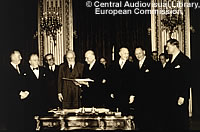
The flag of the European Coal and Steel Community (ECSC) was lowered on 23 July as the Treaty which founded the Community officially expired. The ECSC flag shows six white stars on a blue (steel) background above six white stars on a black (coal) background. The flag was lowered by President of the European Commission Romano Prodi, and handed to Enrico Gibillieri, President of the ECSC consultative committee, the only remaining ECSC institution. The ECSC Treaty was signed in April 1951 by Belgium, France, Germany, Italy, Luxembourg and the Netherlands. Members pledged to pool their coal and steel resources by lifting restrictions on imports and exports and helping to create a single coal and steel market. The ECSC provided a model of international organisation on which the European Community (later Union) came to be based. The ECSC has enabled Europe to maintain a leading position in the field of mining technology and clean coal combustion. Considerable spin off effects have also been seen in other industries. The ECSC's assets and liabilities will now be transferred to the EU. The net worth of these assets will be allocated to the new 'Research fund for coal and steel'. The total fund will amount to 1.6 billion euro, and will gain annual interest of 60 million euro. 72.8 per cent of this will be devoted to steel research, and the remainder to coal research. Research funded under the post ECSC programme will complement activities carried out in individual Member States and within the EU Framework programme. Coordination between the two EU programmes will be encouraged, as will the exchange of information between projects funded under the programmes.