


Mars in their eyes
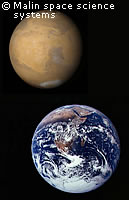
On 27 August, the distance between Mars and the Earth was less than 56 million kilometres, the closest the Red Planet has been to ours for more than 60,000 years. Stargazers and amateur astronomers were treated to views of Mars unrivalled since Neanderthal times, with the distinctive red-orange planet easily visible to the naked eye. Scientists have also taken advantage of the planetary close encounter to record their own observations. When the two planets were at their closest, Europe's Mars Express mission was speeding towards the halfway point in its six month, 485 million kilometre journey, reaching speeds of over 10,000 kilometres per hour. Along with two NASA explorer missions, Mars Express and its Beagle 2 lander will take a close up look at the planet and scour it for signs of life, including evidence of the presence of liquid water. Given the current proximity of the sun's third and fourth planets, however, the use of interplanetary spacecraft is not a prerequisite in the search for life on Mars. Researchers based at the United Kingdom infrared telescope (UKIRT) in Hawaii have used the instrument to collect what they describe as 'perhaps the sharpest image of Mars ever made from the ground.' By applying the same remote sensing techniques that geologists use to map minerals on the Earth's surface, the astronomers are hoping to find evidence of the key life supporting substance - water. As Dr Jeremy Bailey of the Anglo-Australian Observatory explains: 'We're looking particularly for the signatures of minerals, such as hydrated clay minerals, that would indicate the past presence of liquid water.' Dr Bailey believes that the research being carried out using the UKIRT is an important component in the current search for extraterrestrial life on Mars. 'While spacecraft can get up close, ground based observations still have a role, as they allow us to use larger and more powerful instruments,' he said.