


New challenges require new tools, says Busquin in agro-food seminar
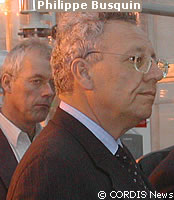
The need for innovative approaches to address the existing and emerging challenges in agricultural policy and research was emphasised by EU Research Commissioner Philippe Busquin on 2 February, at a seminar organised by the European Commission. Hosted by Wageningen University and Research Centre, the seminar was attended by Commission officials and leading experts, who discussed the key challenges facing agricultural policy and research, such as EU enlargement, global competition, consumer distrust, societal acceptance, and contagious disease control. Commissioner Busquin also announced that in addition to the new instruments of the Sixth Framework Programme (FP6), the European Commission was examining the possibility of establishing new technology platforms aimed at creating a European Research Area for agro-food research. Currently, there are some 7 million farmers within the EU, and enlargement will raise this figure to nearer 17 million. As Professor Patrick Cunningham of Trinity College Dublin explained: 'On average [the accession countries'] productivity has been estimated at 11 percent of that of Western Europe, so enormous changes will need to take place in agricultural structures in the Eastern countries in the coming decades'. Professor Cunningham insisted that this was a key macro economic challenge, which had been greatly underestimated by the EU. He went on to argue that globalisation will add to the problem, as recent studies show that for the main food commodities, such as meat, cereals and milk, lowest cost producers in other developed countries can deliver products at less that half the European cost. The combination of those macro economic factors requires that 'agricultural research aim at a better understanding of the inextricable connections between land management, food productions, food technology and human health,' according to Dr Manfred Lückemeyer, of the European agricultural research initiative (EURAGRI). This goes hand in hand with the shift from 'a production to a consumer orientation, and the importance attached now to food quality and safety' added Dr Lückemeyer. This is especially true in the wake of persistent revelations of deficiencies in the food system, which have damaged consumer confidence. Such challenges suggest that the EU needs to be extremely cautious with new food technology. Although the EU has not been at the centre of the recent revolution in genetically modified (GM) food, all major stakeholders are aware that Europe now needs to catch up if it does not want to loose out on the remarkable opportunities for increasing efficiency in food production. 'Balancing justified caution with acceptance of the benefits that science can bring is one of the challenges, not just for scientists and food producers, but for society' said Professor Cunningham FP6 has been a contributing factor in advancing the discussion and in forming European research groups, said Dr Lückemeyer. However, he added that: 'more needs have to be met in order to build an effective and efficient European agricultural research system. Most of the food and agricultural research systems in the Member States are still nationally oriented, but many problems that lie ahead are not limited to national borders. 'Cooperation must be improved on issues that would gain from a joint effort, such as sustainable agricultural and rural development, organic farming and animal welfare. Cooperation is also needed in terms of critical mass, cost effectiveness, efficiency and scope, and a broadening of the database and quality of research,' Dr Lückemeyer concluded. Commissioner Busquin agreed with Dr Lückemeyer's assessment, saying that consumer concerns 'have created new challenges in agriculture and food productions, thus generating new challenges for research.' 'The new instruments of the Sixth Framework Programme - the Network of Excellence and Integrated Projects - allow for large consortia, and projects with a wider and more integrated scope. They should also allow us to integrate biology, chemistry, socio economic and other disciplines, to give us appropriate and complete answers to the challenges we face, he said. The Commission is currently working on the new work programme for 2005 to 2006, and says it will focus on critical activities not covered in the first half of FP6. Mr Busquin also noted that to further increase European cooperation on the emerging challenges in the agro-food sector, the new technology platforms he referred to earlier in his presentation could be created very soon.