


EU-US agreement on Galileo 'taking shape', says Commission
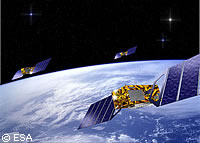
The European Commission has described the progress of negotiations with the United States regarding the interoperability of the Galileo and GPS satellite navigation systems as 'constructive', and says that a possible cooperation agreement is within sight. A two day round of intensive discussions was held at the end of January, and while a final agreement could not be reached, both parties showed a willingness to evaluate the progress that had been made and hold a further round of talks in the second half of February. One of the main barriers to concluding an agreement has been a difference of opinion between the EU and US over the signal structure to be used by Galileo. The US proposed that the European system use a modulation known as BOC (1.1) which would not interfere with its planned M-code military signal. While the EU is willing to pursue a common approach to the Galileo signal, it is understood that there are concerns over the effect on Galileo's accuracy of using BOC (1.1). A Commission official close to the negotiations told CORDIS News: 'We do have another, compromise signal structure, but we need more time to carry out a technical evaluation. The EU is ready to go in the direction of the US, but the most important issue from our side is that any final agreement remains sufficiently flexible to allow for future improvements to the system.' The official stressed that the EU would ensure that any final cooperation agreement between the two partners would not specify a single, 'frozen' signal standard, as this would severely restrict the future development of Galileo. However, he did recognise that alongside technical considerations, military and security rationales would also have to be taken into account by both parties. Other outstanding issues that the two sides will aim to resolve at their next meeting include guarantees regarding the confidentiality of sensitive technical information, the mutual development of national security criteria for satellite navigation, and a commitment to non-discrimination in trade. Progress on Europe's satellite navigation system was made in another area on 6 February, when the Galileo Joint Undertaking (GJU) announced that three consortia have been pre-selected for the next phase of the concession bidding process. The three groups include some of biggest names in the European aerospace industry, and will now enter into detailed negotiations with the GJU before a final consortium is proposed to the Council next year. General Counsellor of the GJU, Hans Peter Marchlewski, told CORDIS News that the Galileo project would be funded through a public-private partnership, with the public sector contributing some 700 million euro. 'That still leaves 1.5 billion euro for each consortium to find in order to make up the 2.2 billion euro budget foreseen for the deployment phase of the project.' Mr Marchlewski concluded that a large element in the evaluation of each consortium would be the feasibility of their plans for generating these revenues.