


IST project to apply 'augmented reality' to industrial maintenance tasks
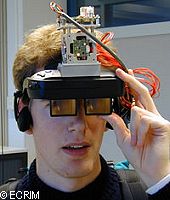
Augmented reality may sound like a futuristic concept, but for someone carrying out complex industrial repairs or maintenance, the availability of computer generated information in their field of vision as they work offers significant advantages. Through the use of a 'near-eye display', someone working on a piece of machinery will also be able to see digital information overlaying the real scene, which could, for instance, demonstrate the step by step repairs that need to be carried out. However, existing examples of such technology require bulky hardware components, severely limiting their usability. In an attempt to secure a truly mobile solution, the Commission is launching a specific targeted research project called ULTRA (ultra portable augmented reality for industrial maintenance applications), under the information society technologies (IST) section of the Sixth Framework Programme (FP6). The main goal of the ULTRA project is to make augmented reality solutions usable on lightweight mobile devices such as personal digital assistants (PDAs), mobile phones and other handheld devices. The consortium of three European companies and a research institute from Singapore must therefore address certain engineering, ergonomic and economic challenges in order to achieve their goal. Project coordinator Didier Stricker, from the Fraunhofer Institute for Computer Graphics, says: 'The market of 3D graphics for handheld devices, such as pocket-PC or mobile phone, is coming. These devices are perfect for mobile augmented reality applications. They are very light, people are used to them and they contain all the functionalities we require, including camera and phone connection.' It is hoped that the 30 month project will deliver a compact system as well as the appropriate software for authoring, workflow edition, context management, tele-consultation and augmented reality. 'It is important to consider the complete process, and everything starts with the generation of digital information. That's why authoring and data management will be as important in ULTRA as the runtime system,' added Dr Stricker. The project is set to receive some 1.7 million euro in EU funding, and will run until early 2006. ULTRA will be officially launched at a kick off event in Darmstadt, Germany, on 16 and 17 September.