


Rehn offers preliminary remarks on the mid-term review of the Lisbon strategy
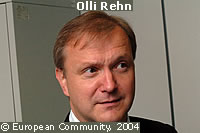
Enterprise and Information Society Commissioner Olli Rehn has said that Europe may have set itself too many targets at the Lisbon Council in 2000, where leaders pledged to transform the EU into the world's most competitive knowledge based society by 2010. Making some preliminary remarks on the mid-term review of the Lisbon strategy, Mr Rehn told guests at an informal dinner for the Competitiveness Council on 23 September that, in his view: '[I]t could be useful to streamline the strategy and better prioritise between our different objectives.' In addition, the Commissioner said that a case could be made for carrying out an assessment of the open method of coordination to better identify its strengths and weaknesses. 'This could give hints as to what can be done to improve its usefulness and whether there are areas where it is more useful than others.' The third point raised by Mr Rehn related to whether or not the Commission has made full use of the instruments available to it to pursue the Lisbon objectives. 'Is there a case for doing more?' he asked. Putting the Lisbon strategy into a wider context, Mr Rehn revealed that at a recent meeting of the future College of Commissioners, President-designate José Barroso reemphasised that competitiveness is his foremost priority, not for its own sake, but because economic growth leads to a higher quality of life. In light of this objective, the Commission is currently preparing a report on competitiveness that will highlight several key industrial challenges facing Europe. These include the changing nature of China's influence on the world economy, where labour intensive exports are fast being replaced by technology driven products; the importance of leveraging private research investments through public policies; and the need for a renewed emphasis on the production and diffusion of information and communication technologies, in light of their positive contribution to productivity growth. In order to achieve progress and drive the Lisbon agenda forward, Mr Rehn believes that the role of the Competitiveness Council must be enhanced in order to take account of the impact on competitiveness of proposals that are outside its own direct remit. 'For example, in the context of next year's Spring European Council discussions on medium and longer term emission reduction strategies, the Council could make an important input to the discussions on the competitiveness aspects,' he said. Policy makers must learn to enact clear and predictable rules which safeguard public values and put a minimum burden on businesses and their capacity to innovate, concluded Mr Rehn, adding that the Council and the Commission must practice what they preach when it comes to better regulation.