


International consortium unveils largest Universe simulation ever
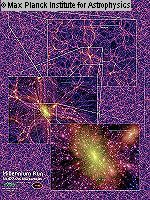
After five years of work, an international consortium of scientists, drawn largely from Europe and led by the Max Planck Institute for Astrophysics, has developed the largest computer-based simulation of our Universe ever. Known as the 'Millennium Run', the simulation promises to offer new insights into cosmic structure and galaxy formation. The Virgo consortium, which includes astrophysicists from Germany, the UK, Canada and the US, revealed the first results gained using the Millennium Run data in the 2 June edition of the scientific journal Nature. They used it to trace the evolution of matter distribution of around ten billion 'particles' in a cubic region of the Universe over two billion light years across. This effort alone kept the Max Planck Society's most powerful supercomputer busy for over a month. Our most powerful radio telescopes have been able to image the Universe when it was only 400,000 years old, when the cosmic structures were weak ripples in an otherwise uniform sea of matter and radiation. Thanks to gravity, these ripples were eventually responsible for the evolution of all the cosmic structures we see today, and it is precisely this evolution that the Millennium Run was designed to study, enabling scientists to explore the complex physics that gave rise to galaxies and the black holes that lie at their centres. Despite the excitement generated by the first results from the Millennium Run, the Virgo consortium argues that the most interesting observations are still to come. According to Simon White of the Max Planck Institute for Astrophysics, who heads the consortium's activities in Germany, 'New observational campaigns [using telescopes] are providing us with information of unprecedented precision about the properties of galaxies, black holes and the large-scale structure of our Universe. 'Our ability to predict the consequences of our theories must meet a matching level of precision if we are to use these surveys effectively to learn about the origin and nature of our world. The Millennium Run is a unique tool for this. Our biggest challenge now is to make its power available to astronomers everywhere so that they can insert their own galaxy and quasar formation modelling in order to interpret their own observational surveys,' he concluded.
Countries
Canada, Germany, United Kingdom, United States