


Ministers 'keen' on i2010, says Luxembourg Presidency
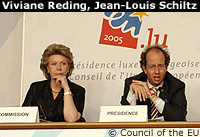
The EU Telecommunications Council welcomed the proposal 'i2010: European Information Society 2010' when ministers met on 27 June. '[T]he ministers have been quite keen on the initiative,' said Luxembourg's Minister Delegate for Communications, Jean-Louis Schiltz, which will be further discussed under the British Presidency EU Information Society and Media Commissioner Viviane Reding attended the Council and presented the initiative, intended to foster growth and jobs in the information society and media industries. The main objectives of 'i2010' are to achieve a single European information area, to bolster innovation and investment in information and communication technologies (ICT) in order to support growth and employment, and to create a European information society so as to improve the quality of public services as well as quality of life. Also on the agenda was the common EU line for negotiations at the World Summit on the Information Society (WSIS), to be held in Tunisia in November. It is hoped that delegates at the summit will reach an international consensus on the issues of Internet governance and financial mechanisms for bridging the digital divide between developed and developing countries - the two key unresolved issues from the first WSIS Summit meeting in Geneva (December 2003). The ministers discussed how to set up a new model for cooperation in Internet management, to include all governments alongside the private sector and civil society. This pertains, for example, to domain names, cyber security, and xenophobic and racist websites. The Council expressed its support for a 'light' intergovernmental cooperation model on Internet governance based on the current bottom-up public-private partnership, which should also provide a platform for policy dialogue in the interest of all governments in a fast-reacting and flexible way. The issue of funding for ICTs as a tool for economic and social development and for achieving the Millennium Development Goals was also raised by the Presidency; the top priority of the WSIS being to overcome the 'digital divide' - the discrepancy between wealthy populations that have access to new technologies, and poor populations, who continue to be excluded from the digital revolution.