


IRC key to Europe's competitive future, says Verheugen
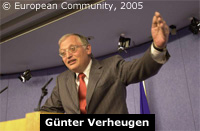
Innovation Relay Centres (IRC) have built up a very good reputation since they were established ten years ago, with many third countries looking to learn from the network, said Commission Vice President Günter Verheugen, responsible for enterprise and industry policy. However, he added, they now need to be even more ambitious than in the past and contribute further to the Lisbon strategy. Speaking at the IRC's annual meeting, which took place in Brussels on 29 June, Mr Verheugen insisted that the IRC network is crucial in helping to achieve the Lisbon objectives, from which the EU is currently very far. 'Innovation is the key to opening the door to a brighter economic future,' said Mr Verheugen. 'If we want to overcome Europe's current stagnation and raise its capacity for growth, we have to reduce the gap between the EU and the US in innovation performance. The IRC network is enabling SMEs [small and medium-sized enterprises] to play a crucial part in reaching this goal.' David White, Director of the Directorate D: Innovation Policy at the European Commission, explained that IRCs have an essential role to play at three different levels: regional, university and industry. 'We strongly believe that regions have a crucial role to play in supporting innovation. It is at this level that most support for firms comes from,' stated Mr White. 'IRCs have, therefore, the task to open to localities the door to the wealth of EU knowledge and experience. IRCs can also stimulate the way regional innovation plans get drawn to enable firms to move from regional to EU level and achieve greater visibility and success,' he added. In terms of universities, Mr White explained that IRCs can help them to both show the latest, state of the art technology to businesses, and to help businesses present universities with their needs and requirements. Mr White called on IRCs to increasingly get involved in this process, and encouraged them to stimulate the creation of spin-offs. Turning to industry, Mr White stated that 'IRCs should develop the support they can offer to SMEs to participate in European research projects. IRCs must provide information to SMEs, help them assess that information and help them prepare for presentations and proposal writing.' Concluding, Marco Mangiantini from Italy's Alps IRC explained that different companies have different approaches to business, but that their success lies in the fact that they all have the same focus on innovation and technological development. 'The basic premise is that innovative technology is the lifeline of industrial competitiveness. Focusing on R&D [Research and Development] is essential to face competition in a global way, and the only way to go for European industry to achieve the Lisbon objective,' Mr Mangiantini said.