


Reding calls on China to open ICT sector up to foreign investors
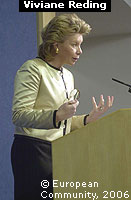
Information Society and Media Commissioner Viviane Reding has delivered a speech in Shanghai calling on China to continue liberalising its economy and open up important sectors such as information and communication technologies (ICT) to foreign investors. Speaking at the China Europe International Business School (CEIBS) on 16 January, Ms Reding said that she had been extremely impressed by the European and Chinese companies that she had seen working in China's ICT sector, confirming her belief that EU-China cooperation has a long future. 'The aim of my visit is to see my Chinese counterparts and industry players from both [the] EU and China discuss ways of promoting our bilateral relations and industrial cooperation,' said the Commissioner. 'For the European business community present in China, a key element is of course trade and investment.' However, Ms Reding said that she was struck by the list of remaining obstacles to trade and investment cited in a recent position paper by the European Chamber of Commerce in China. 'European industry is investing heavily in China and is a growing source of technology transfer and employment for China. But it faces a number of difficulties in the information society sector,' she said. As an example, Commissioner Reding cited so-called 'value added services' in China, an area where some 16,000 licences have been issued, but only four of which were issued to foreign companies. 'And this is not for a lack of interest by foreign companies. Rather it is a result of a licence application process which is far more burdensome than most other countries,' said Ms Reding. 'So-called 'basic' services, too, are difficult for foreign companies to enter, owing to restrictive regulations,' she continued. 'This is linked not only to the ceilings set by the Chinese government for foreign organisations but also a range of additional restrictions on the choice of Chinese partners for 'basic' services.' In addition, Commissioner Reding expressed concerns over the development and implementation of international standards in China, the implementation of IPR agreements, and the lack of transparency in the introduction of third generation mobile services. 'Four years after China's WTO accession China has made enormous strides and foreign companies are making huge investments. But legal certainty is not sufficient in some ICT areas, and this needs to change,' warned Ms Reding. '[T]he EU expects the Chinese government to maintain its commitments to WTO rules and to the WTO spirit.' 'The EU is willing to increase its cooperation on research and its support in the area of dialogue on future-oriented information society and media services,' concluded Ms Reding, highlighting the benefits to China of cooperation with international partners. 'I hope that gradually the Chinese government will continue the liberalising of China's economy and opening up important sectors to investors.'
Countries
China