


EU agrees part-funding of world's largest telescope
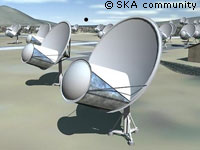
Planning for the giant 'Square Kilometre Array' (SKA) radio telescope will be part-funded by the European Commission, under infrastructures priority of the Sixth Framework Programme (FP6). The Commission will fund 27 per cent of the cost, 38 million euro over the coming four years. The SKA is an ambitious project which already has partners in 18 countries, including France, Germany, Italy, the Netherlands, Poland, Russia, Sweden and the United Kingdom. The array combines the signals generated from several different individual telescopes - the combined effect being greater than the sum of the parts. The project will develop the largest telescope ever constructed, and the four-year design study will bring together some of the greatest minds in astronomy to agree the final plan. The projected final budget for the project is 1 billion euro. Professor Richard Schilizzi is the International SKA project director. 'Designing and then building, such an enormous technologically-advanced instrument is beyond the scope of individual nations. Only by harnessing the ideas and resources of countries around the world is such a project possible,' he said. European expertise will focus on phased array receivers, which are similar to aircraft radar receivers. These give conventional radio dishes a 'wide angle', enabling vast tracts of sky to be studied simultaneously. When the array goes online in 2020, it will be essential in answering some of the most fundamental questions in astronomy, such as 'what is dark energy?', 'how did the universe form?' and 'was Einstein's general theory of relativity correct?' The project got off the ground through a desire to learn more about hydrogen in space. Hydrogen is the most abundant and simplest element in the universe, and a better understanding of this gas will inform us about the movement, mass and distribution of the galaxies and, ultimately, the big bang. The SKA blueprints require such vast computing power that current supercomputers would not be able to deal with the number of computations necessary to make the SKA work. However, when the project goes on-line, in 14 years, new generations of computers will be available that will cope. The SKA's collecting area will be one million square metres - equivalent to about 200 football pitches. The SKA will be so sensitive that it could detect television broadcasts coming from the nearest stars, should there be any.
Countries
Argentina, Australia, Brazil, Canada, China, Germany, France, India, Italy, Netherlands, New Zealand, Poland, Russia, Sweden, United Kingdom, United States, South Africa