


Women doing better in education, but still underrepresented at top end of academia
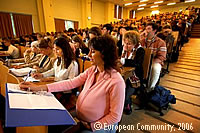
The EU's 2006 annual report on equality between women and men paints a mixed picture of the situation in Europe, with women performing better at certain stages of education, but still lagging behind men in terms of employment and pay. In his foreword to the report, EU Commissioner for Employment, Social Affairs and Equal Opportunities, Vladimir Spidla, notes that 'women today account for the majority of university graduates and [...] their access to employment, and hence their economic independence, has been steadily growing.' Indeed, in 2004, almost 80 per cent of women aged between 20 and 24 had completed at least upper secondary education, while less than 75 per cent of men had done so. At first degree level, women are again more numerous, and more successful than men, representing 59 per cent of all graduates. At PhD level, the share of women decreases to 43 per cent however, and only 15 per cent of Grade A full professors are women. Differences in fields of study also remain, with women underrepresented in engineering, science and technology, and more likely than men to be found studying health, education or the humanities. Turning to lifelong learning, more women than men follow adult education and training courses in 21 EU Member States, with an average participation rate of 11.7 per cent among women and 10 per cent among men. The EU has in the past emphasised the increasing importance of achieving gender equality in science in the context of competitiveness. If the EU is to have the most competitive economy in the world by 2010, more must be invested in research and development (R&D), says the Commission. And in order for the Member States to invest more in R&D, more scientists are needed - between 600,000 and 700,000 if investment in R&D is to reach three per cent of GDP. Encouraging more women to enter into science and to stick with science after studying it, is one way of increasing the number of people working in science in Europe. In the April 2005 Competitiveness Council, ministers invited the Member States to increase the number of women in leading research positions, with the goal of reaching 25 per cent in the public sector. In its annual report, the Commission states that gender equality is essential for the European strategy for growth and employment, but adds that the Member States' national reform programmes show 'reduced visibility and a loss of momentum of gender issues'. It adds that 'Europe needs a reaffirmed commitment to the Community approach, combining gender mainstreaming and specific positive actions, supported by effective institutional mechanisms.' The challenges laid out in the report include fully exploiting the gender policy contribution to the European strategy for growth and employment; promoting an effective reconciliation of work and private life; and ensuring that gender aspects are taken into account in the EU's external relations.